Goodman:
“Several weeks ago we heard about a young guitar player working in a little
night spot in Oklahoma City. After listening to the enthusiastic reports, we
sent for him. We heard him play for the first time a couple of days ago and
decided the reports were true. He’s a Texan by the way of Oklahoma City and
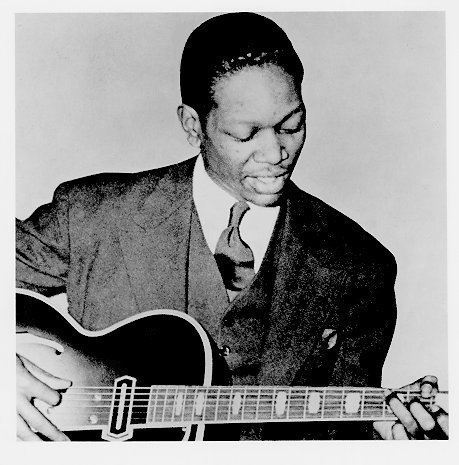
now … I want you to meet Charles Christian.
[applause]
“After we heard Charles
play the guitar we got another idea about a new group within the band. A
group consisting of the piano, bass, vibraharp, drums, guitar and clarinet.
The tune we’ll play is Flying Home – a number we made up at rehearsal
yesterday.”
4-Bar Intro + 4
CHORUSES:
4 bars
– piano
(Intro)
16 bars
– CC & ens
(Theme)
8 bars
– clarinet
8 bars
– CC & ens
(Theme)
♪
32 bars
– CC
16 bars – vibes
(over CC chord
accents)
8 bars – vibes
(over CC riffs)
8 bars – vibes
(over CC chord
accents)
16 bars
– CC & ens
(Riffs)
8 bars
– clarinet
8 bars
– CC & ens
(Riffs)
[applause]
a Jerry Newhouse recording
Personnel:
Benny Goodman Sextet
CHARLIE CHRISTIAN
Guitar
BENNY GOODMAN
clarinet
LIONEL HAMPTON
vibes
FLETCHER HENDERSON
piano
ARTIE BERNSTEIN
bass
NICK FATOOL
drums
Composed by:
Charlie Christian -
Leslie Sheffield - Lionel Hampton
The “Camel Caravan” radio series featuring the Goodman
band had been aired every Saturday night for the past three years and would
continue for four more months until the end of 1939. Tonight’s half-hour
program – performed this one time at The Hollywood Bowl – included several
tunes by the orchestra (less Charles) and one by the sextet.
Having been hired into the sextet just three days earlier, this was Charlie
Christian’s first gig. Fortunately, one of the two pieces recorded on
this evening’s program was the selection by the sextet featuring Charles – his
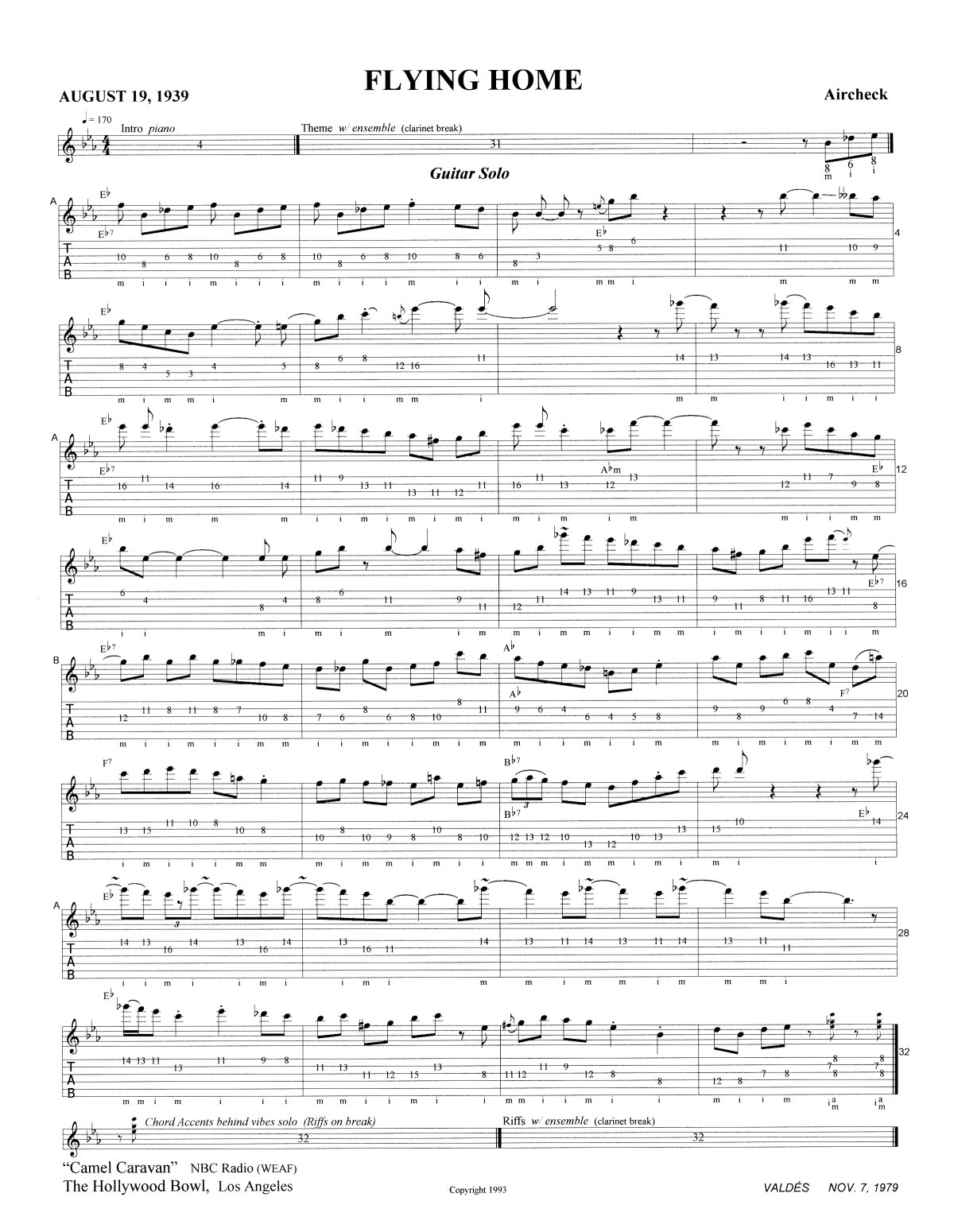
very first recorded solo on his own composition, Flying Home. Straightaway a superb
fully-formed soloist is revealed.
CC starts off with a four-note figure that he subsequently used on several
other recorded versions of the tune – here the figure is repeated four
times, more than on any of the other iterations. It is an amazingly
effective start to an electrifying outing on one chorus. As would be the
norm, the exhilaration moves up a notch at the bridge. This was but the
first of many more treasures to come in the next couple of years.
There are many skeptics of the tablature applied to the transcriptions on
this site. I would suggest to them to set aside their conventional
chord-pattern improvising method that came out of the book and at least try
this, Charles’ initial solo. The actual fingering that I advocate is not as
difficult for an experienced guitarist as it may seem at first – the most
difficult part is getting rid of ingrained habits. A few minutes of
concentrated effort will reward with an enlightened understanding and a
truly joyous discovery of a new way of finally being able to phrase a solo
as Charlie Christian did. Can’t be done any other way – to sound like
Charles, you have to stroke the guitar like Charles.
It works well even if one has to take it at a tad less than full tempo.
Issued Recordings:
[ LP ]
Jazz Archives
JA-23
(side A, track 1)
Musica Jazz
2MJP 1058
(side A, track 1)
[ CD ]
Archives of Jazz
380123 2
(track 1)
Archives of Jazz
389123 2
(track 1)
Definitive
DRCD11177
(disc 1, track 1)
Galaxy
389944 2
(track 1)
Golden Stars
GSS 5461
(disc 1, track 5)
Jazz Classics
JZCL-5005
(disc 1, track 1)
JSP Records
JSP909
(disc 1, track 1)
Le Jazz / Charly
CD 11
(track 1)
Masters of Jazz
MJCD 24
(track 1)
Masters of Jazz
MJCD 9004
(disc 1, track 1)
Music Memoria
87998 2
(disc 1, track 1)
Proper
P1491
(track 1)
Proper
PROPERBOX 98
(disc 3, track 1)
Stardust
CLP 1150-2
(track 1)
Uptown
UPCD 27.63
(track 5)
Vintage Jazz Classics
VJC-1021-2
(track 1)
Incorrect date of August 10, 1939
appears on some releases.
All text and images in this site protected
by copyright laws.
No text or images (including transcriptions) may be copied, reused, or altered without
written permission from the owner of this site.