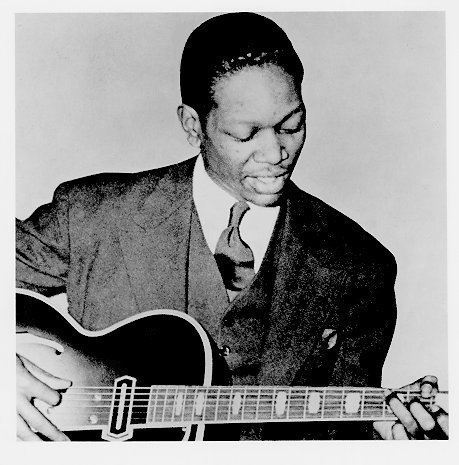
|
THIS IS THE STORY OF THE MOST INFLUENTIAL MUSICIAN
AND
THE FINEST GUITAR PLAYER EVER
|
The term
genius is
originally a derivation of ‘genii’; a
term from Roman mythology referring to spirit, either the internal
driving force within all living things, or a specific spirit with
supernatural powers. A similar term from Arabic legend is
‘jinnee,’
‘djinn,’
or
‘genie’ which is familiar to us in the tales of Aladdin and his magic lamp
in One Thousand and One Nights (aka Arabian Nights).
In modern
usage, a ‘genius’
is a person with distinguished mental prowess. This can manifest
either as a foremost intellect, or as a creative talent. The term
does specifically apply to mental rather than athletic skills.
A
‘genius’ is someone whose mental faculties are recognized to be so
extraordinary that they go far beyond what a non-genius is capable
of. They make huge original leaps in their field, rather than just
extending the previous body of work in that field. Their faculties
include a rich power of invention, a talent for creation, and an
insight from which novel ideas flow in streams. A
‘genius’ is one who
can direct this peculiar gift towards a specific employment, whether
in the intellectual fields or creative arts.
All of
that applies to our subject, Charles Christian,
the Indisputable Genius
of Music.
It may be apparent to the lay person that Charles and
few others are obviously geniuses and the more we delve into the
interdisciplinary fields of genetics, psychology, and neuroscience
the more clear it becomes to us that Charles definitely falls into
the category of genius. But we are not here to discuss the
now-available methods, theories, or technology such as brain
scanners that were unavailable back in his day. Let us just say that
Charlie Christian was born with a natural gift that was nurtured by
his family, friends, and environment, and that he had the immense drive
and motivation to take full advantage of that brilliance. |
AN INDISPUTABLE GENIUS
|
Charles Henry Christian
(July 29, 1916 – March 2, 1942)
Prelude
Charlie Christian was the African-American jazz guitarist who transformed
the music world with his innovative electric guitar techniques and masterful improvisations. His dazzling single-note style unshackled the instrument from
the rhythm section, and his feats of melodic daring blazed early trails into bebop. In a short life of just twenty-five years, Charles forever changed the
world of music.
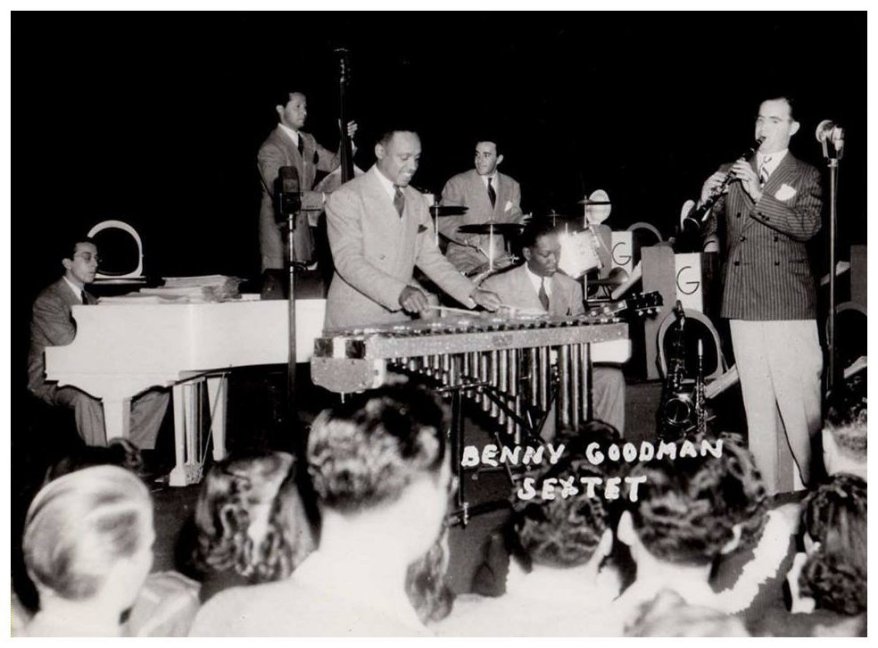
Charles burst into the jazz scene when he gained national exposure as a member of the Benny Goodman Sextet and Orchestra and in less than two
years, from August 1939 to June 1941, indelibly impacted the history of music. For a scant 22 months, Charlie Christian occupied center stage of the jazz world,
and then he was gone, as suddenly as he had appeared. Charlie Christian was like a supernova – a sudden flash of brilliant light, here and gone in the blink of an eye.
He was among the first electric guitarists and a key figure in the
development of bebop and cool jazz and transformed the guitar from a
rhythm instrument into a leading solo voice in jazz. His
single-string technique, combined with amplification, helped bring
the guitar out of the rhythm section and into the forefront as a
solo instrument. Charles is often credited with leading to the
development of the lead guitar role in jazz and popular music
ensembles and bands. Producer John Hammond and jazz writer George T.
Simon called Christian the best improvisational talent of the swing
era.
|
|
Early Life
Charles Henry Christian was born in Bonham, Texas, a small town
(population 5,000 at the time) about 70 miles NE of Dallas, not far from the Texas-Oklahoma border. It was best known as the hometown of Sam Rayburn,
a 24-term congressman and Speaker of the United States House of Representatives for over 17 years. Charles’ paternal grandmother, Callie, had worked
in the Rayburn residence. Charles was born into a musically talented and supportive family. Both of his parents were musicians. He had two older
brothers: Edward, born in 1906, and Clarence, born in 1911. Edward, Clarence, and Charles were all taught music by their father, Clarence James
Christian (ca. 1872-December 12, 1926), who was proficient on most instruments.
Clarence James played baseball in local black leagues, preferred
sacred music, and worked as a compress operator at the local cotton mills and part time as a train porter or a waiter at the Hotel Alexander. Charles’
mother, Willie Mae Christian (March 29, 1890-March 6, 1958), a distinctly beautiful woman, was a pianist in the local silent-movie theater and worked as a chambermaid at
the Hotel Alexander. In Bonham,
the Christians lived at 511 West Johnson Street in an area called Tank Town because of a water tank belonging to Bonham Cotton Mills that could be seen
directly behind the Christian’s home. They were a very close-knit, loving family, but because of his effervescence Charles was everyone’s favorite.
 Charles Christian in Bonham
Before Charles’ second birthday his father was struck blind by an inexplicable malady,
and in order to support the family he and the boys worked as buskers on what the Christians called “busts” (if one didn’t get paid it was a “bust”). He would have
them lead him into the better neighborhoods, where they would perform for cash or goods. Clarence Sr would play various instruments,
Edward usually played a mandolin, Clarence Jr (nicknamed “It”) would be on a violin. When Charles was old enough to go along, he first entertained
by dancing if he wasn’t accompanying his family as a boardbeater. Later he learned to play the guitar, inheriting his father’s two instruments upon
his death when Charles was ten. By the time Charles was a teenager he was already very proficient on the guitar.
Two days after Armistice Day, 1918,
his family moved (via Paris, Texas where they had some relatives) to Oklahoma City, Oklahoma, where his maternal grandmother, Ella Georgia, was already
living. Clarence Sr found work with the railroad and the Christians continued with their busts. After Clarence James’ passing the Christians lived on
20 South Geary Avenue and in 1933 moved to 813 NE First Street
Charles attended Douglass High School in Oklahoma City, where he was further encouraged
in music by the musical director for all grade levels in the Black public schools, Zelia N. Breaux, a woman written about in heroic terms by Ralph Ellison,
who also studied under her. At one time Ms Breaux also co-owned the Ira Aldridge Theater on Second Street in partnership with Fred Whitlow. As Ellison wrote in his 1958 essay
The Charlie Christian Story, “there were also a concert band and orchestra, but Christian – an exceptionally gifted teenager… – shunned them.” Charles
wanted to play tenor saxophone in the school band, but Ms Breaux insisted he play trumpet instead. As he believed playing the trumpet would disfigure his lip,
he quit to pursue his interest in baseball, at which he excelled as pitcher and, occasionally, infielder. In a few short years Charles would take up his father’s
favorite instrument.
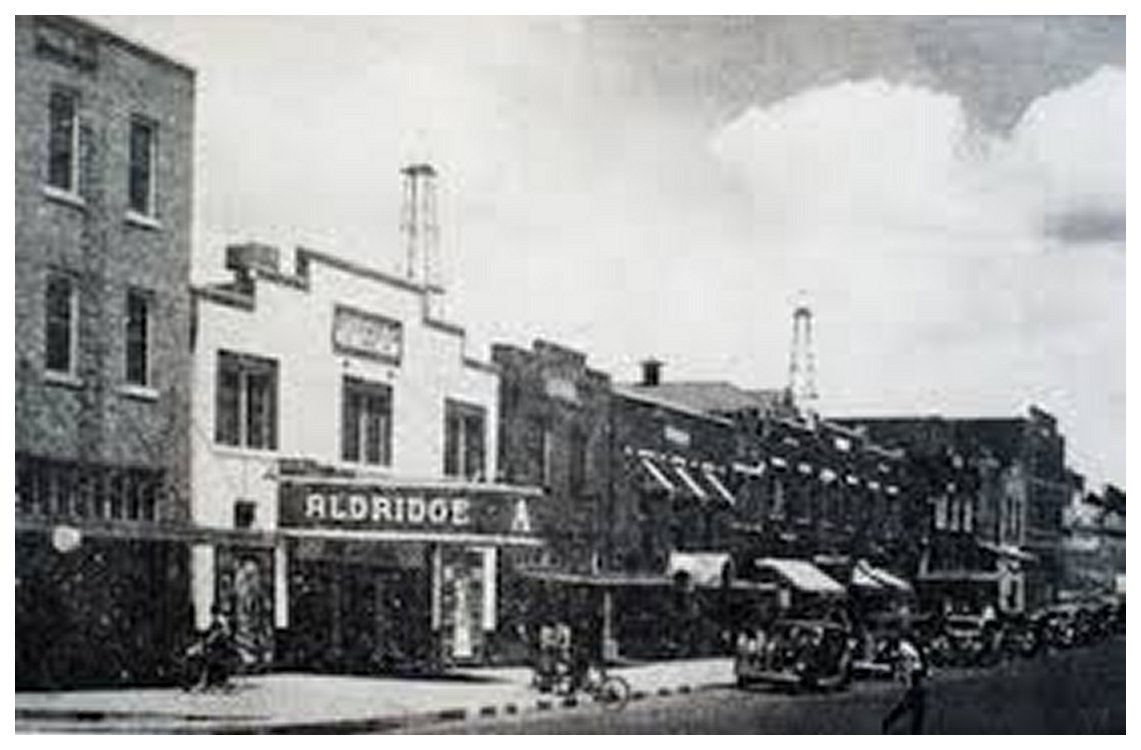 Aldridge Theater (white building), Deep Deuce
Whenever Charles did something, he would put all his energies into it. And so it was when he turned seriously from baseball to music – several years after his
father died when Charles was ten years old – he started to hang with musicians, particularly guitarist Ralph ‘Big-Foot Chuck’ Hamilton and trumpeter James
Simpson. Charles’ brother Clarence claimed Charles was fascinated with the music of Duke Ellington. Also that wearing fine clothes was an obsession to Charlie
Christian. Duke Ellington told Clarence Christian in 1942, “People will be listening to your brother’s music 20 years from now.” As Clarence would put it, “That
boy was somethin’!”
In an interview with biographer Craig McKinney, Clarence Christian
said that in the 1920s and 1930s, Edward Christian led a band in
Oklahoma City as a pianist and had a shaky relationship with the
trumpeter Simpson. Around 1930, Simpson had instructed guitarist
Hamilton to secretly school the younger Charles in jazz. Hamilton
taught him to solo on at least three songs, “Rose Room,” “Tea for
Two” and “Sweet Georgia Brown.” Also Christian introduced his
boyhood friend, T-Bone Walker, the now-prominent blues
singer/guitarist, to Hamilton, who virtually taught them together.
Hamilton was a chord player, nonetheless the two young guitarists
took that and developed their own revolutionary solo styles.
|
|
First Public Appearance
When the time was right, Clarence (‘It’) took Charles to one of the many after-hours jam sessions at Honey’s along “Deep Deuce,” where their older brother was playing piano with the Don Redmond band. Hamilton was also there jamming with the band on guitar. “Let me play one,” Charles beseeched Edward. “Charles, nobody wants to hear them old blues,” Edward replied. Edward didn't know Charles had learned to play. After some convincing from Hamilton, he allowed Charles to join in. “What do you want to play?” he was asked. He chose a tune that most of the crowd knew and was popular with the people. He selected "Sweet Georgia Brown." The choice was a surprise to Edward, but the band began to play with Edward setting the pace at piano. The song began with soloists each putting in their part. Then it was Charles’ turn.
“And Chuck told him, ‘Come on, Charlie, you can do it’. Charles set there, and they encored him back for sixteen choruses, and every one of those choruses was different. And my oldest brother like to went through the ceiling. ‘Hey, hey man! This is my brother! This is my brother! Take another one, Charles. Take another one!’ You know he was going out, you know...”
His impromptu debut that evening was a surprise to many people. Charles’ sixteen choruses were single note solos and this was “way before he started playin’ professionally.” Charles’ brother, Edward, was very surprised, to say the least. Edward was unaware that Charles had been studying music and the guitar under Simpson and Hamilton. The simple reason for his ignorance was a difference that had come up between Simpson and himself. Both Edward and James Simpson were pursuing the same young lady. Because of this, very little was said between the two.
After this first number at Honey’s, everyone was quite excited and wanted to hear more of Charles on guitar. Charles was asked to choose another number. He politely and shrewdly explained he was not the leader of this session, he was just “sittin’ in” with the rest of the musicians. Actually Charles had only three songs he knew well, and wanted to play in front of others. He finally suggested they play “Tea for Two” and everyone agreed. Charles again electrified the awaiting crowd with his music. He exploded into his music, and the crowd reciprocated in appreciation.
After “Tea for Two” Charles thanked the rest of the guys for letting him play, telling them he felt better now. But everyone wanted to hear more. Charles was very aware he had only one more tune he felt secure playing with this group of musicians. The others begged him to play once more. He consented to one more number, and he chose “Rose Room.” The crowd was genuinely amazed by what it had heard that night, performed by a young, local musician. This was Charlie Christian’s first public appearance on guitar.
It was the talk of the neighborhood, and word spread fast. When Clarence and Charles, who were the closest of brothers, arrived back home, their mother already knew all about what had happened. And the effect of the incident on Charles’ eldest brother’s opinion of his baby brother' talent was permanently altered. Charlie Christian went on from there to become what some have called, “the world’s greatest jazz guitarist.”
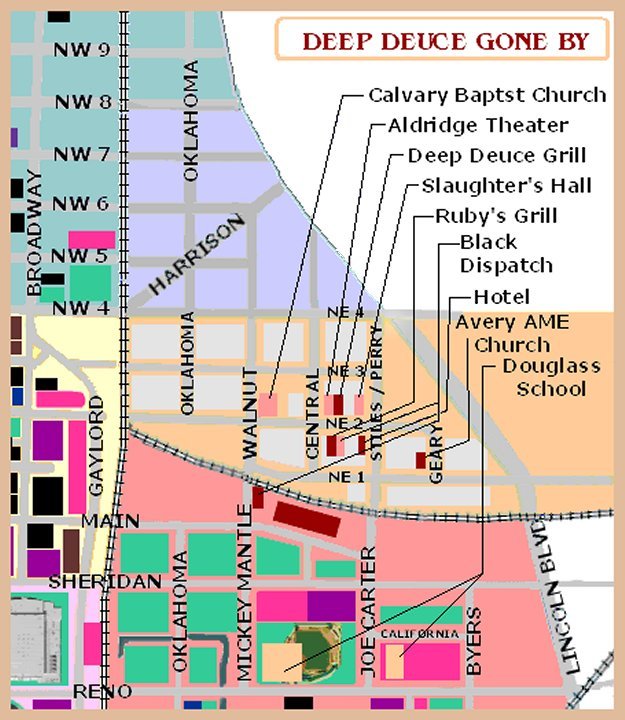
Cadastral Map of
“Deep Deuce” as it was in the 1930s
Byers Avenue was renamed Charlie Christian Avenue
on December 5, 2006 “Deep Deuce” was only one block long, on the 300 block of Northeast Second Street between North Central Avenue and North Stiles Avenue, the heart
of the city’s Black community. This was the place to go to with restaurants, hotels, tailor, billiard halls, doctors, two barber shops, music store, hardware store, lawyers,
funeral home,
The Black Dispatch newspaper, the Aldridge
Theater which served as a movie house as well as a venue for blues
and jazz concerts and for traveling minstrel and vaudeville shows,
and for silent movies with the music provided by the Blue Devils band.
This was like a Mecca drawing in business by day and entertainment by
night. Then there was Slaughter’s Dance Hall, third floor
above Randolph’s Drug Store, where one could dance to the music of
the best of the “territory bands” including the bands of Count
Basie, Don Redman, Bennie Moten, Andy Kirk – all of them. Charlie
Christian’s favorite purlieu was in Ruby’s Grill at 322½ NE 2nd St
where he could jam with the local musicians and members of the
territory bands. All-night sessions were the norm. He had his own
swing band “Charles Christian & His Electric Guitar” there at
Ruby’s.
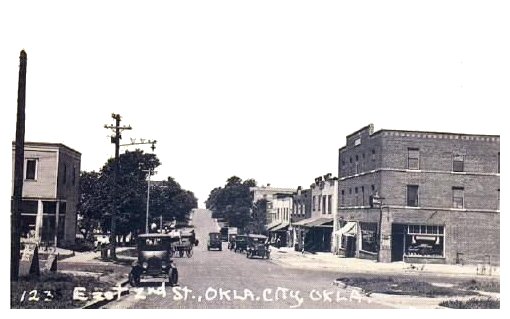
Slaughter’s Hall is the three-story bldg on the right
Ruby’s Grill is across the street, middle of the block
|
|
Margretta and Billie
Charles fathered a lovely
daughter, Billie Jean Christian (December 23, 1932 – July 19, 2004)
by the charming Margretta Lorraine Christian (November 30, 1917 –
November 16, 2011) originally from Paris, Texas. Margretta had moved
to Oklahoma City with her mother in 1928 where she attended
elementary school, then entered Douglass High School two years
later. Their families knew each other and introduced them at the
school grounds where he was playing baseball. Margretta had been one
year behind Charles in school and as she recalled, “Charlie left
school probably in the ninth going into the tenth grade…he left more
or less because of he and I had a child together, and he left school
after that.” Margretta and Charles continued a close relationship –
when Charles was away they corresponded familiarly by mail.
Billie
was Charlie Christian’s only child.
|
|
Inception
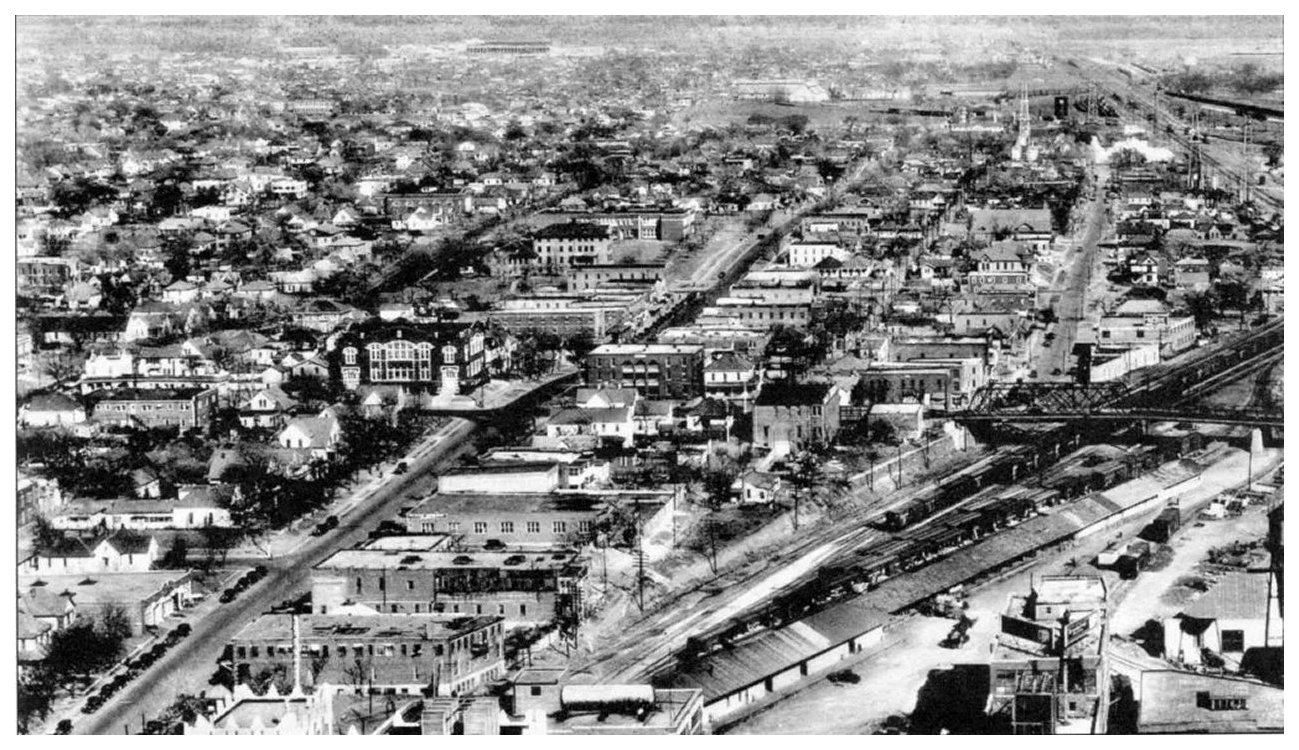
Deep Deuce
in Early 1930s
Calvary Baptist Church can clearly be seen just left of center
Charles was soon performing locally, especially jamming at trumpeter James Simpson’s new outdoor joint, The Rhythm Club. There was now another
place in Deep Second to rival Ruby’s Grill just across Second Street. And there was yet another joint “The Hole,” almost next door, in a basement –
above it, on the first floor, was the Band Box which had been a pool
hall. Next door to Ruby’s Grill
was the office of Roscoe Dunjee, the noted civil-rights advocate and editor of
The Black Dispatch, the local weekly newspaper. It was around this time that Charles’ eldest brother, James, had a regular
weekly column in The Black Dispatch covering the local music scene.
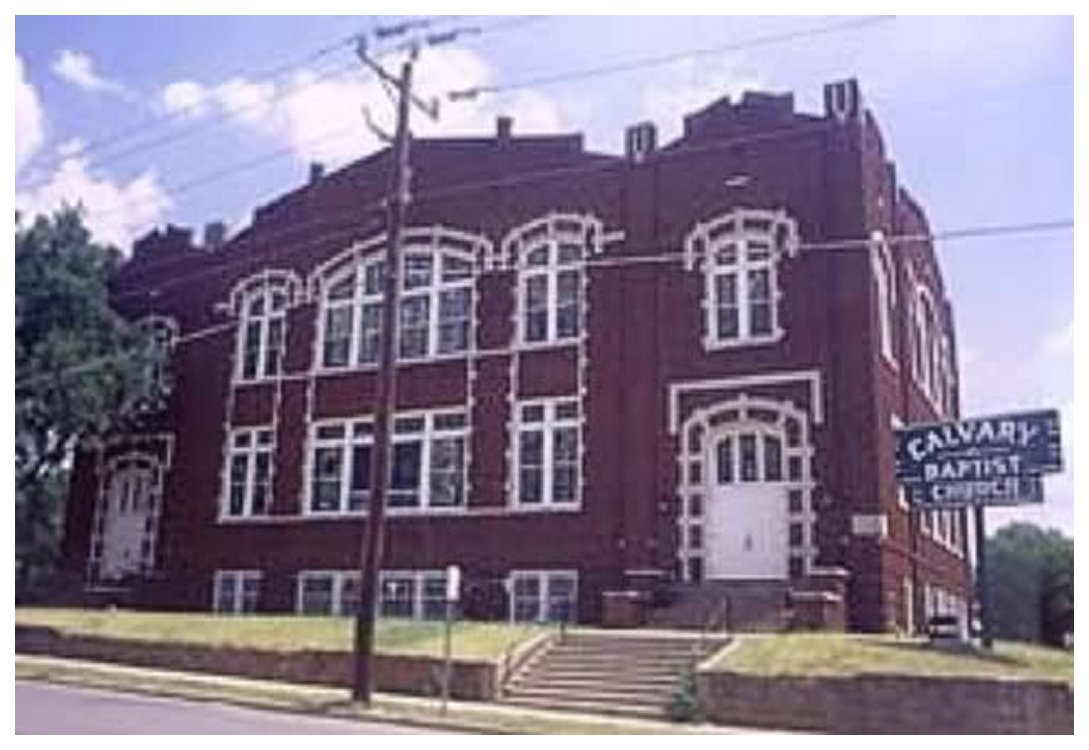 Calvary Baptist Church on Walnut Street.
Second Street runs along the right side on photo.
There was another place where Charles would go to jam – a ballroom called Salathiel’s Barn in the south part of OKC owned by the father of
two white brothers that Charles was acquainted with, fiddle player Merle and his younger brother, guitar player Doyle Salathiel. Charles would get together
with them and their Western swing friends at their remodeled barn and jam the night away. The Salathiels and their friends would reciprocate and venture
over to Deep Second, most often to “The Hole” which was run by Big Bridges, to pass the bottle around and play jazz and, presumably, Western swing. Merle
later formed his own big band, Merl Lindsay and his Oklahoma Night Riders, a well-known troupe that included Doyle and their nephew, guitarist Max Salathiel.
The Encyclopedia of Oklahoma History and Culture:
“This cultural confluence of different genres of American music allowed Oklahomans to experiment, innovate, and improvise, all necessary traits in the formulation of jazz. Within this cultural mosaic, music knew no color. In multiethnic, multiracial Oklahoma cross-cultural experiences and free exchange of repertoires and musical styles favored the development of jazz.
“Oklahoma's major cities, such as Oklahoma City, Tulsa, and Muskogee, served as training grounds for Oklahoma jazz artists.
“Deep Deuce,” or Northeast Second Street, was the core for Oklahoma City jazz. Institutions such as the Aldridge Theater, Ruby’s Grill, Richardson’s Shoe Shine Parlor, and Rushing’s Café catered to jazz musicians and enthusiasts. Uptown ballrooms, such as the Ritz, were also important outlets. In addition, in the 1920s and 1930s numerous bands, including the Jolly Harmony Boys, Pails of Rhythm, and Ideal Jazz Orchestra, worked out of Oklahoma City. The city produced many notable jazz artists, including Jimmy Rushing, Henry Bridges, Charlie Christian, and Don Cherry. Tulsa's Greenwood District also offered a number of jazz outlets, such as The Rhythm Club, Casa Dell, Rialto Theater, and The Hole and developed bands led by Ernie Fields, Al Dennie, and Clarence Love. Tulsa also produced numerous jazz luminaries, including Howard McGhee, Earl Bostic, and Cecil McBee. Second Street in Muskogee likewise was an active center for jazz with outlets such as Stem Beach and the Yale Theater. Musical productivity per capita was highest among cities in Oklahoma, rather than rural areas, and generated such jazz legends as Jay McShann, Claude Williams, Barney Kessel, Don Byas, and Aaron Bell.
“Finally, local musicians were influential in the early development of Oklahoma’s artists. Music educators such as Zelia N. Page Breaux, Evelyn Sheffield, and Cornelius Pittman at Oklahoma City’s Frederick Douglass High School provided sound formal training for aspiring musicians. For example, among Breaux’s former students who cited her as an inspiration in their jazz careers were Buddy Anderson, Jimmy Rushing, and Lemuel Johnson. Local bandleaders, such as Ernie Fields, Eddie Christian, Clarence Love, and Al Dennie, offered opportunities for singing and playing instruments in their respective ensembles.
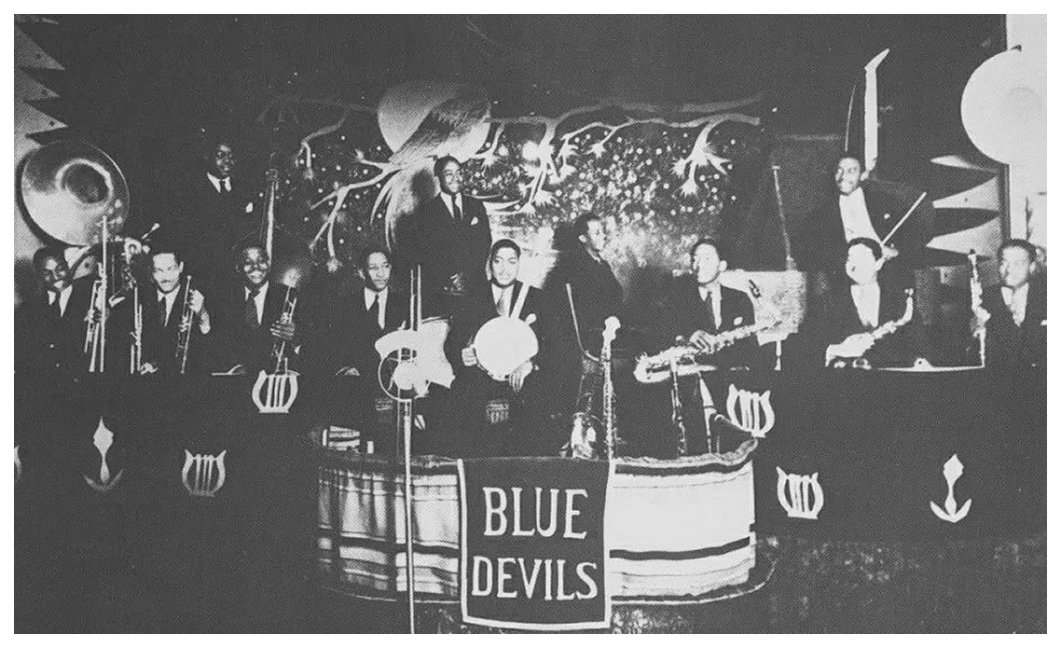
Ritz Ballroom, OKC
Walter Page’s Blue Devils
“Oklahoma and surrounding states were blessed with a number of
“territorial bands,” or those that traveled a circuit, such as the Oklahoma City Blue Devils. Several of these blossomed into major forces in the development of jazz in the Southwest and Midwest. The Blue Devils at various times included native Oklahomans Jimmy Rushing, Abe Bolar, Don Byas, and Lemuel C. Johnson. Additional territorial bands to employ Oklahomans were Andy Kirk and his Clouds of Joy (Don Byas, Howard McGhee, and Claude Williams), Bennie Moten Orchestra (Jimmy Rushing, Ed Lewis, and Earl Bostic), Terrence Holder Orchestra (Bostic and Williams), and George E. Lee Orchestra (Ted Donnelly and Elmer Crumbley). A vast majority of Oklahoman musicians migrated from the state and were tapped to perform in the big bands and bebop combos in major American cities. For example, Jay McShann, Ed Lewis, and Claude Williams succeeded in Kansas City. Los Angeles provided opportunity for Wardell Gray, Barney Kessel, and Chet Baker. Oscar Pettiford, Don Cherry, and Don Byas went to New York City. In those venues jazz was more readily accepted than in the South, and more professional facilities existed for recording as well as radio work.
“Because of its rural orientation, sparse population, and lack of a metropolitan center Oklahoma failed to retain most of its noteworthy professional jazz musicians. The allure of major recording studios, more and better quality performance arenas, and larger markets for jazz affected the Oklahomans' decisions to leave the state in order to seek and achieve fame and fortune. Unfortunately, few came home to exercise their talents on a permanent basis before home-state audiences. Fortunately, jazz music scholars now recognize that Oklahoma's contributions to American jazz were underemphasized in the genre’s history.”
In the spring and summer
of 1935 Charles was with Leonard Chadwick and His Rhythmaires; in summer and fall of that year he was with Leslie Sheffield and his Rhythmaires (Sheffield
had taken over the band). When they were in OKC the band had engagements at the Ritz Ballroom on 15½ Walker Boulevard. Charles was playing acoustic guitar
with, on solos, a mike held between his knees. The bands would be on the road throughout the Midwest, including states as far away as North Dakota and
Minnesota. In 1936 Christian and T-Bone Walker played in Dallas during the Texas Centennial. Walker and Christian occasionally played shows as a duo,
alternating on bass and guitar. At times, Charles’ brother, Edward, would play piano with them.
Reportedly Charles purchased his first electric guitar, a Gibson, in 1937 and had, by then, become a regional attraction. According to record producer John
Hammond, Christian jammed with many of the big-name performers traveling through Oklahoma City, including Teddy Wilson, Art Tatum, and Mary Lou Williams, the
pianist and arranger for Andy Kirk and His Clouds of Joy. Christian had established a local following and was heralded for his unique single-note soloing style
and masterful improvisation.
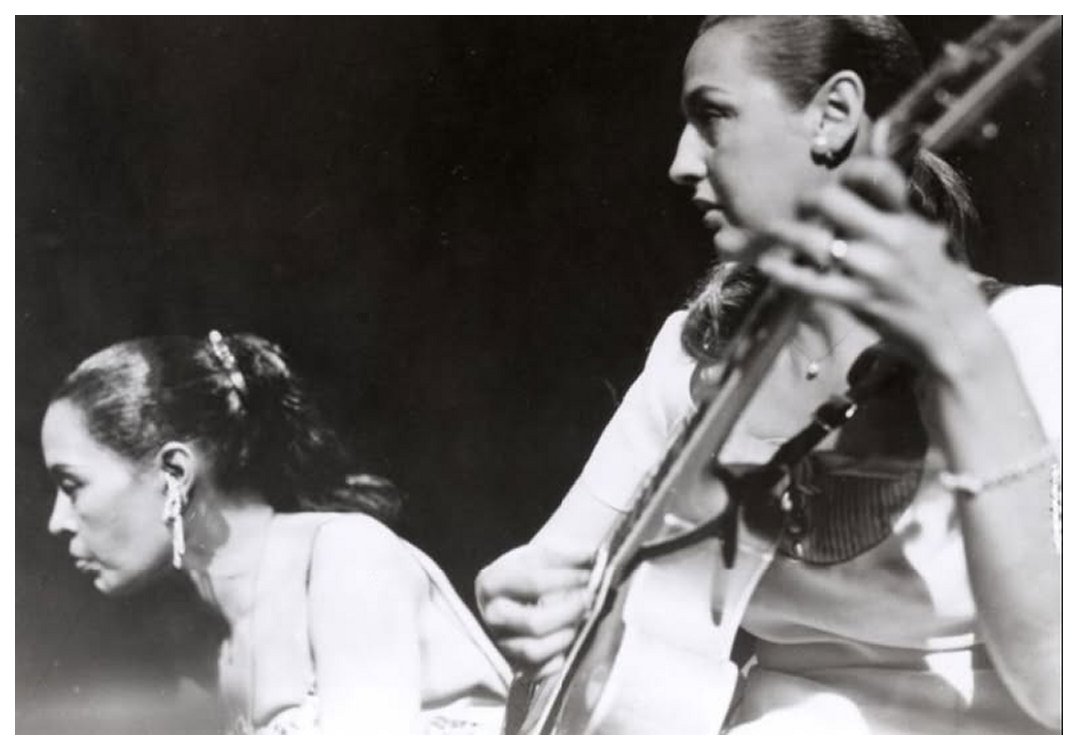
Mary Osborne on guitar
Around 1936-1937 he toured with Alphonso Trent and his orchestra for about a year where a talented young guitarist heard him in
September 1938 at The Dome in Bismarck, North Dakota. Mary Osborn described Charles as “very nice, exceptionally nice.” At times Charles played bass with Trent to
protect his guitar from rough and rowdy miners in the Midwest. He went back home for a while before he traveled north again with Anna Mae Winburn and her
all-male orchestra. This tour didn’t end well. The band went broke and lost their touring bus when it was seized and returned to the receivers. The band
was stranded. Charles’ family had to rescue him and bring him home.
After this, during the spring of 1939, Christian returned to his home in Oklahoma City where he alternated playing (and getting plenty of solo time) with
Leslie Sheffield and his Rhythmaires or Edward Christian and his Blue Devils, sometimes known as Edward Christian and his Harlem Devils; then in the summer
with his own band, billed as “Charles Christian & His Electric Guitar – One of the Southwest’s Most Popular Swing Bands.”
True anecdote: July 10, 1939. Andy Kirk and his Cloud of Joy had an
engagement at the Ritz Ballroom in OKC. Kirk had some of Charles’
friends in his band including tenor saxophonists Dick Wilson and Don
Bias, and pianist Mary Lou Williams. Also in the band was steel
guitarist Floyd Smith who was a recognized luminary due to having a
recent hit with “Floyd’s Guitar Blues” featuring him with the Kirk
band. After the show at the Ritz, members of the band encouraged
Smith, who was a bit haughty at the time, to accompany them to the
jam at Ruby’s Grill. Smith took his guitar with the intention of
cutting Christian in a match of improvisation. It’s not known for
sure if after listening to the less-experienced guitarist he just
sat there or if he actually played a solo before Charles took his
turn. In either case, the abashed Smith packed up his ax and left to
the amusement of his bandmates who continued to tease him
mercilessly for some time. They had known something Smith did not:
nobody ever challenged Charlie Christian – trying to cut him was
utterly futile.
|
|
“Discovery” and Audition
It was in July 1939 when Mary Lou Williams, arranger and pianist for Andy Kirk and His Clouds
of Joy, heard Christian play and pronounced him the “greatest electric guitar player” she’d ever heard. She was instrumental in persuading
New York music producer John Hammond to give Christian an audition.

Mary Lou Williams
“The Lady Who Swings the Band”Here are some Mary Lou Williams’ recollections:
“I think I was the one really got him to join Benny Goodman. I used
to jam with Charlie in a little club in Oklahoma City when we passed
through town with Andy Kirk’s band, and one night in 1939 I asked
him if he was going to take the Goodman job. I don’t think he wanted
to leave Oklahoma City, and I don’t think his family wanted him to
leave, either—maybe because they already knew about his sickness.
All he said was ‘Mary, I’ll join if you’ll join, too.’ There was
some talk about my going with Goodman, but I told him go ahead
anyway, and he did.
Later, whenever I was in New York with Kirk, I’d
look Charlie up and we’d go to a basement room in the Dewey Square
Hotel, usually around ten in the morning, and sometimes we’d jam,
just the two of us, until eleven at night. It smelled down there and
the rats ran over our feet and only ten keys on the piano played,
but we didn’t pay any attention. All those little figures that later
became the famous riff numbers that Goodman recorded would come out
[Christian rarely received credit for them], and after we’d played a
couple of hours he’d put down his pick and play classical guitar and
things like ‘Rhapsody in Blue.’ It was beautiful.
He wasn’t a
swellheaded person at all. He was very sweet and easygoing—a sweet,
thin, easygoing person. Fact, I only saw him mad once. At one of our
sessions, he said, ‘Mary, can’t you call Benny and tell him to stay
out of my solos? He keeps coming in in the middle of them, and I
think if he doesn’t quit I’m going back to Oklahoma.’ Of course, he
never did. The last time we played together, he must already have
been quite sickly, because the only thing he wanted to eat was ice
cream.”
This
is another account from a 1954 Mary Lou Williams interview in British weekly music newspaper
Melody Maker:
“Our tour took us to Oklahoma City again. Jack Teagarden had given me his family’s phone number, so I called Norma Teagarden and she came to our dance. Norma talked about a remarkable guitarist named Charlie Christian, who played electric guitar and was raised in Oklahoma City. Norma is supposed to have taught Christian music, and she told us he could play everything from jazz to the classics. His favorites were
‘In a Mist’ and ‘Rhapsody in Blue.’
Our guitarist, Floyd Smith (who replaced Ted Brinson), considered he could improvise with the best of them, and the guys in the band were anxious to see what he’d do after hearing Charlie. So after the dance everyone tore out to the club where Christian worked. I rode there with Pha Terrell, and when we got in the two guitarists were down with it: Floyd playing his head off for two choruses, then Charlie taking over – very cool.
For a while it was a close call, then Charlie decided to blow. He used his head on cutting sessions, the way Chu Berry used to do, taking it easy while the other musician played everything he knew, then cutting loose to blast him off the map.
“Never in my life had I heard such inspired and exciting music as Christian beat out of his guitar. Poor Floyd gave it up and walked off the stand. Charlie played for us till daybreak.
I knew many leaders, including Benny Goodman, had tried to get Christian. Up to now he had refused to leave Oklahoma. But feeling that he and jazz should have a break, I asked him would he leave to join BG if I wired New York. Finally he said:
‘Okay, if you say so, Mary.’ I wired John Hammond right quick, and John (who had heard Charlie previously) got together with BG. In the summer of
1939 Christian made the move, and Benny thanked me on one of his broadcasts for getting him for the band.”
On his way to Los Angeles to set up plans for the
recording of Benny Goodman’s band under their brand new contract
with Columbia Records,
John Hammond stopped in
Oklahoma City on August 3rd to hear Charles for himself. He met with
Charles at the Lyons Den in Ruby’s Grill where Charles was working
and it was decided to hold the audition the following evening at the
Hucksins Hotel where his mother worked and where Hammond happened to
be staying.
 John Hammond, Columbia Records producer
Although he didn’t think much of the other
players, Hammond was immediately impressed with Charles and noted that Christian was “endlessly inventive” and was very surprised that such
a great guitarist had not been “discovered” before. He immediately set forth to convince Goodman that “Charlie Christian belonged in the Goodman
small group.” Benny was disinclined and Hammond continued “you won’t believe him until you hear him.”
Hammond, who happened to be Benny Goodman’s
brother-in-law, finally convinced Goodman when he pointed out that he could hire Charles with some of the funds provided by the sponsor of the
“Camel
Caravan” radio show. After Hammond left Oklahoma, Charles was left with no idea of what Hammond thought of him. Finally, about ten days later Charles
received telegram “Come at once. Have position with Benny Goodman.” Clarence recalls that “Charles set down and laughed ‘how am I going to make it to
Los Angeles if I ain’t got cab fare down town’.” While family and friends went about getting some money for the trip, Charles wired Hammond of the
situation. Hammond promptly sent Charles $300 for train fare, followed by another telegram “If this is not enough, will wire more. See you.”
John Hammond then orchestrated
a surprise audition of Christian with bandleader Benny Goodman in
California. A going-away party was organized for August 13 at Ruby’s
Grill on Deep Second. The next afternoon Charles was on the train
headed for his audition.
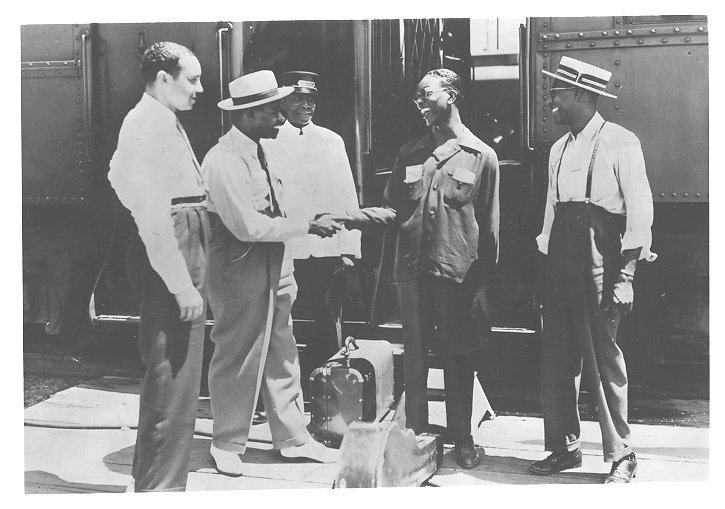
Boarding the Super
Chief on his way to fame and glory |
|
National Fame
When Benny Goodman brought in Teddy Wilson on the piano in 1935 and Lionel Hampton on vibraphone in 1936, he became only
the fourth white bandleader to feature Black musicians in his live band.
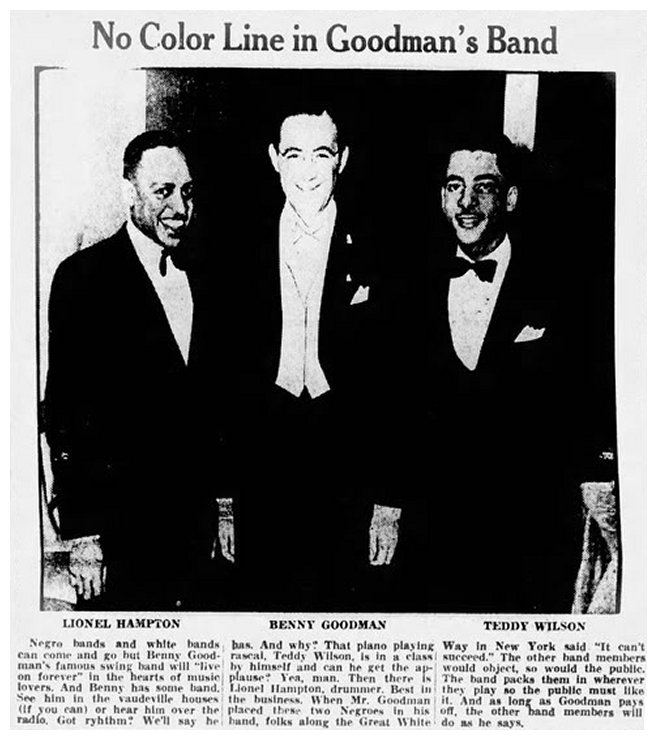 Hampton – Goodman – Wilson
Goodman was initially uninterested in hiring Christian because the electric
guitar was a relatively new instrument to him. Goodman had been exposed to the instrument with Floyd Smith and Leonard Ware, among others, none
of whom had the ability of Christian. There is a report that Goodman unsuccessfully tried to buy out Floyd Smith’s contract from Andy Kirk.
Floyd Smith 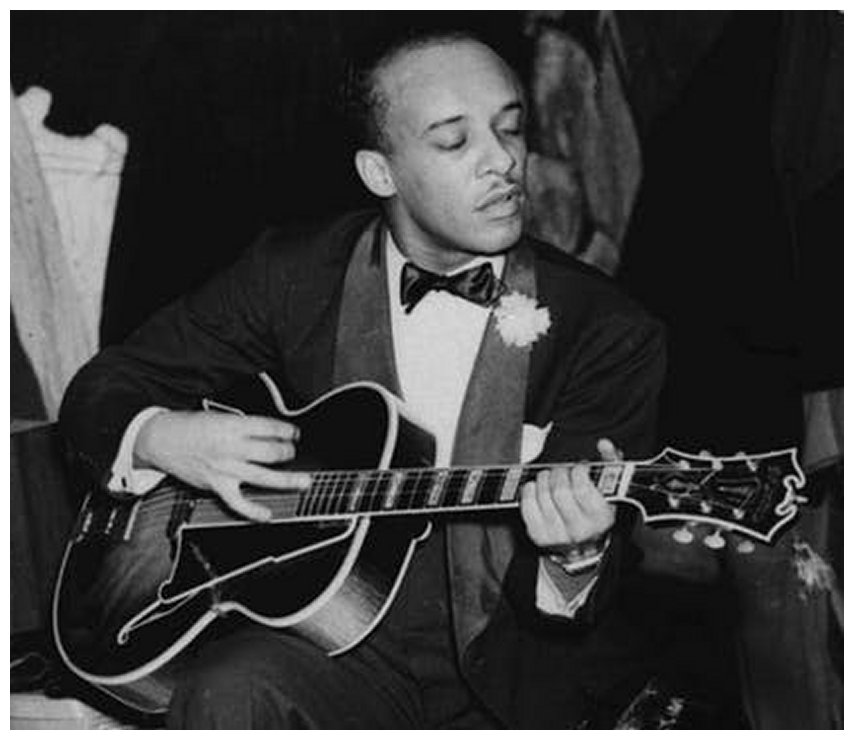 Leonard Ware
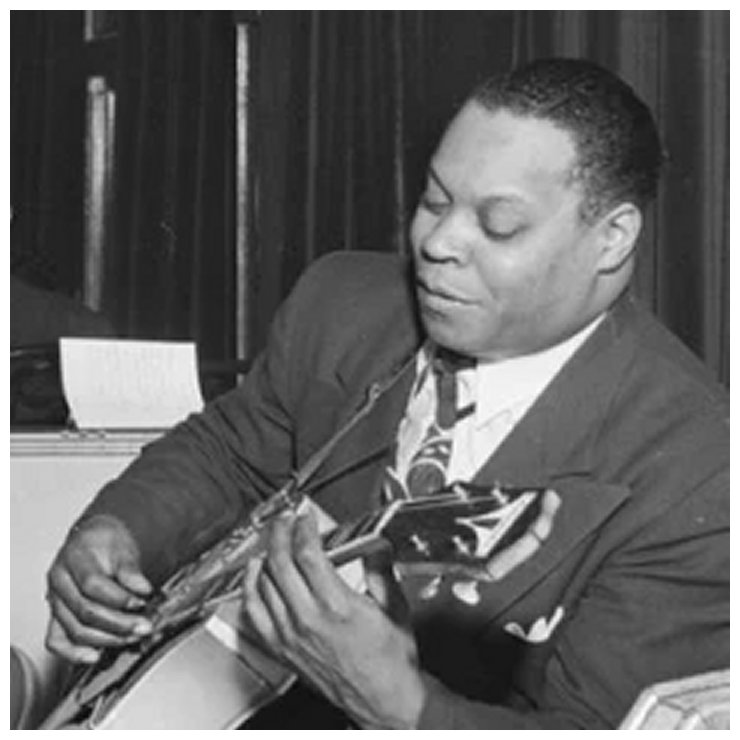
There are multiple accounts of Christian and Goodman’s first meeting on August 16, 1939. The encounter that afternoon at the recording studio had
not gone well. According to his brother, Charles had said “I was so nervous with him sitting there looking at me. I could hardly play.” It was a hasty
affair where Charles was not even given enough time to plug in his amplifier; he auditioned acoustically. Christian recalled in a 1940 article in
Metronome magazine, “I guess neither one of us liked what I played,” but Hammond decided to try again – without consulting Goodman. (Christian says
Goodman invited him to the show that evening.) He installed Christian on the bandstand for that night’s set, on opening night for the band, at
The Victor Hugo restaurant in Beverly Hills.
.jpg) The Victor Hugo
The Victor Hugo
.jpg)
When Charles walked in, Benny stopped the set and
walked off the bandstand leaving Charles just standing there.
Empathetically lending Charles a hand, Artie Bernstein
welcomed him to sit with the rhythm section.
Displeased at the surprise, Goodman called “Rose Room,”
a tune he assumed Christian would not be familiar with. However, Christian was well acquainted with the tune and took an unprecedented twenty choruses of
improvisation, all of them different, and all, unlike anything Goodman had heard before. That version of “Rose Room” lasted forty-seven minutes, according
to the bloviating Hammond. By its end, Christian was in the band. Hammond later verily said “I had never seen anyone blown away like Benny was that night.”
“Benny went crazy when he heard him,” said Jerry Jerome, a Goodman band member. “He’d never heard a guitar player that could sound like a tenor
saxophone. . . . The solo work was wonderful.” Goodman hired him on the spot as a member of the band. Actually, not the full band yet – Christian
had joined the nascent Goodman Sextet which included Lionel Hampton, Fletcher Henderson, Artie Bernstein and Nick Fatool.
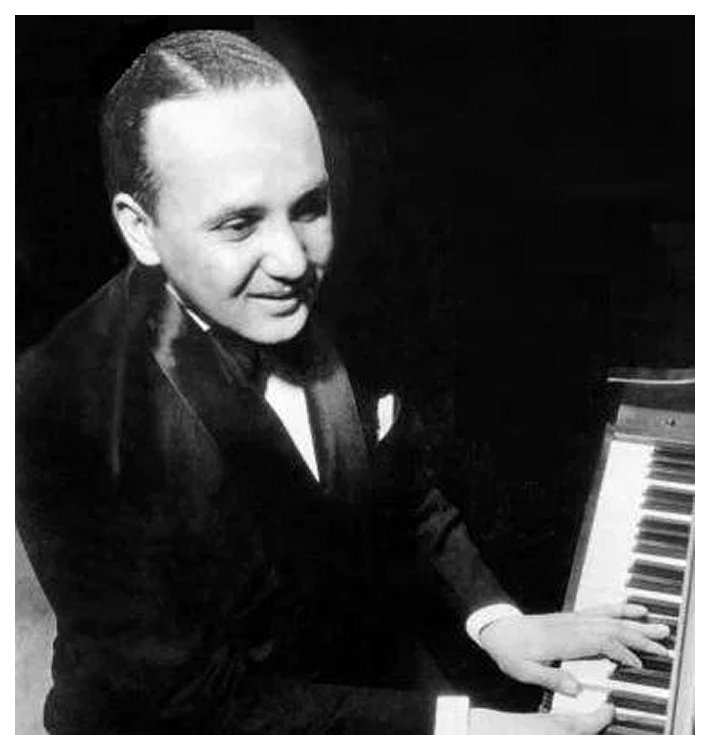 Henderson
  Bernstein
 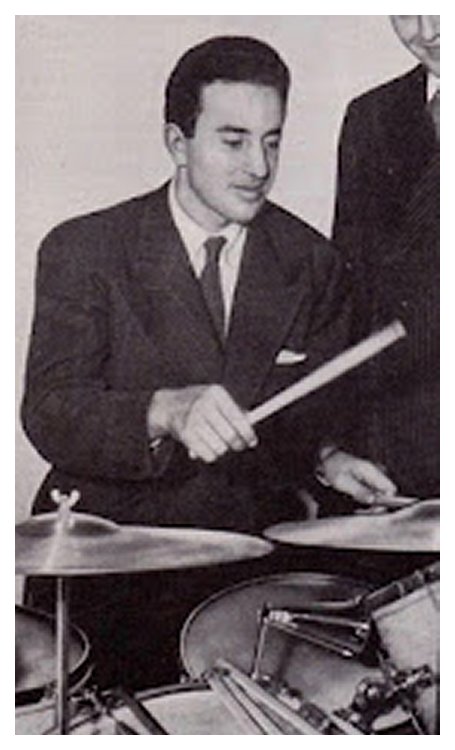 Fatool
In the course of a few days, Christian went from making $2.50 a
night to $150 a week. His family back home received a large part of
every paycheck he drew. Charles had recently bought
a new Gibson to replace his Epiphone guitar and had just started paying off the debt. Now he could get his Gibson bill paid off by the Goodman organization
with some of the train fare Hammond had sent him. Due to his meteoric rise in fame, it wasn’t long before the Gibson company was periodically providing Charles
new Gibsons.
Charles’ first gig with the sextet must have been quite a sublime
experience for the young guitarist from Oklahoma. He had traveled
extensively throughout the Mid-West but never to the West Coast. He
now found himself suddenly playing his guitar within the bandshell
of the stunningly impressive Hollywood Bowl, the internationally
known amphitheater in the Hollywood Hills of Los Angeles.
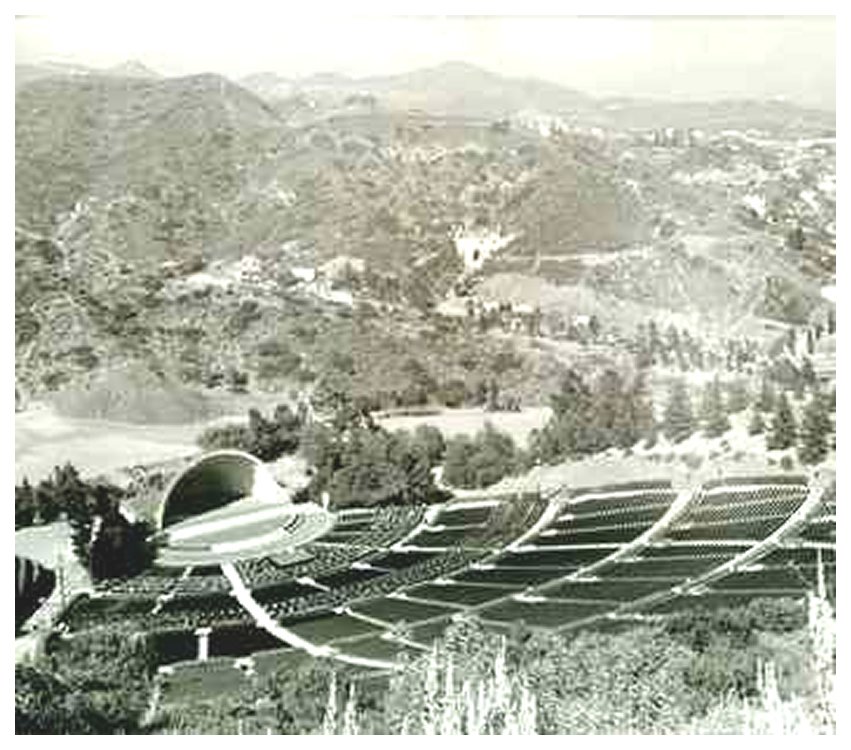 The Hollywood Bowl
This was Charles’ first time in the national spotlight and it was
with the most popular band in the country. His composition, “Flying
Home,” which he had brought with him from the Leslie Sheffield band,
was chosen as the piece to be played (and recorded) at this August
19th concert.
The band toured to Kansas and Toronto, then to Detroit where the sextet played the guitar feature, “Star Dust.” Goodman’s
introduction was “You've all heard ‘Star Dust’ played by the trio, the quartet, and the band. The other night while the new group in the band, the sextet, were
jamming, Charlie Christian, our new guitar player, fell out in a chorus of ‘Star Dust’ that no one ever heard before – nearly broke up the session. So, tonight
we thought you’d like to hear this: the sextet playing ‘Star Dust’.”
Benny insisted that Charles play the same solo every time he played that song with the sextet. The only time Charles was recorded with a different solo on this song
was on an Eddy Howard pop session and that one was only eight bars long. When his mother had asked him to dedicate a song to her, Charles had replied that every time
he played “Star Dust” it would be dedicated especially to her. Incidentally, when Charles was first hired, Willie Mae had made Goodman promise her that he would take
good care of her son. Goodman did just that, treating Charlie better and, recognizing and appreciating his musical talents, showing him more respect and much more
tolerance than he did the others in the band.
 Michigan State Fair 1939 poster
That “Star Dust” was recorded at the Michigan State Fair, on the air, on September 2, 1939, and then another aircheck
of “Flying Home” was recorded a week later with the sextet from the “Camel Caravan” show before Charles was invited to record on his first studio session. The band was
at the New York World’s Fair from September 6 through 11 but did not get recorded.
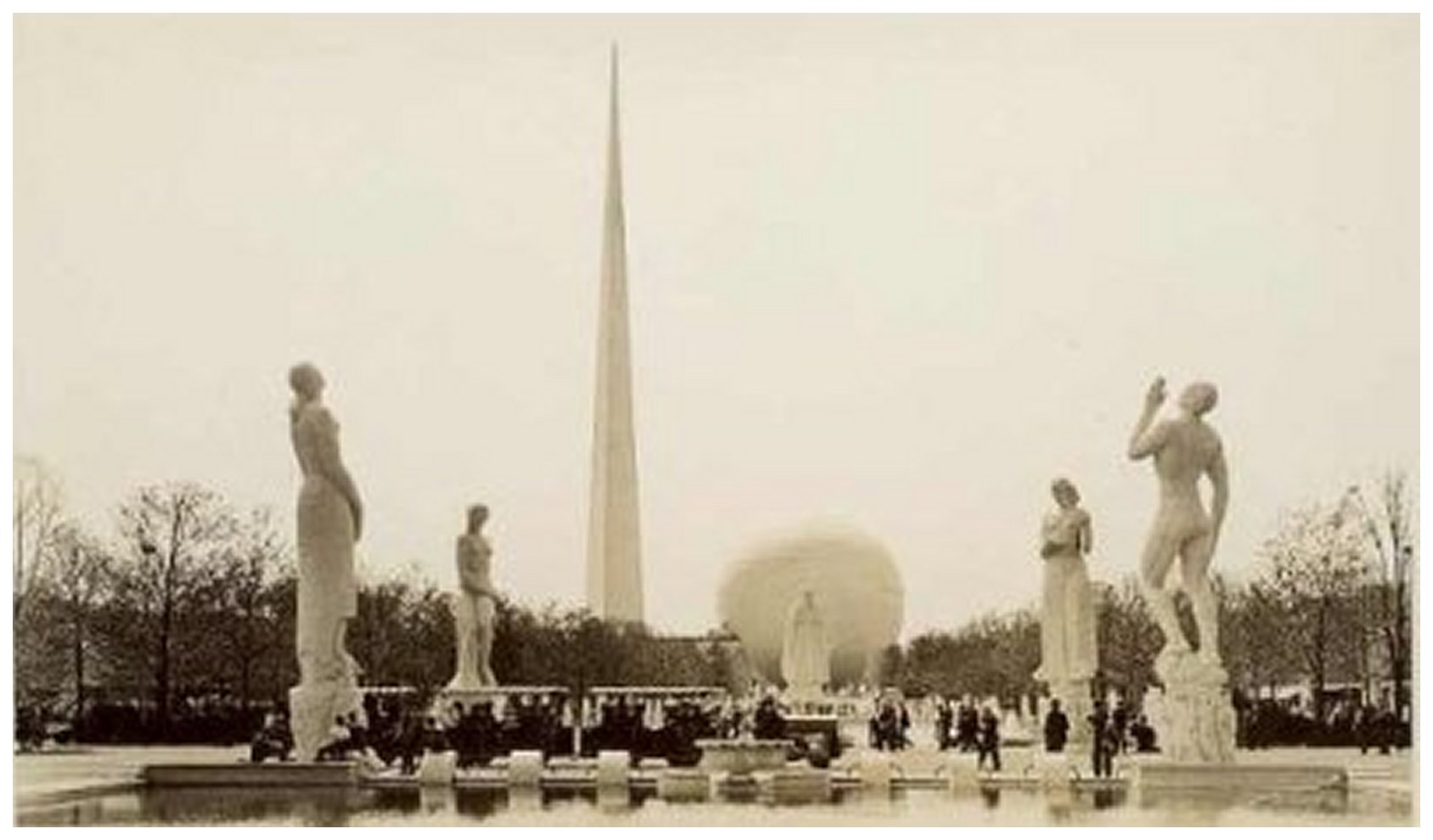
New York World’s Fair 1939
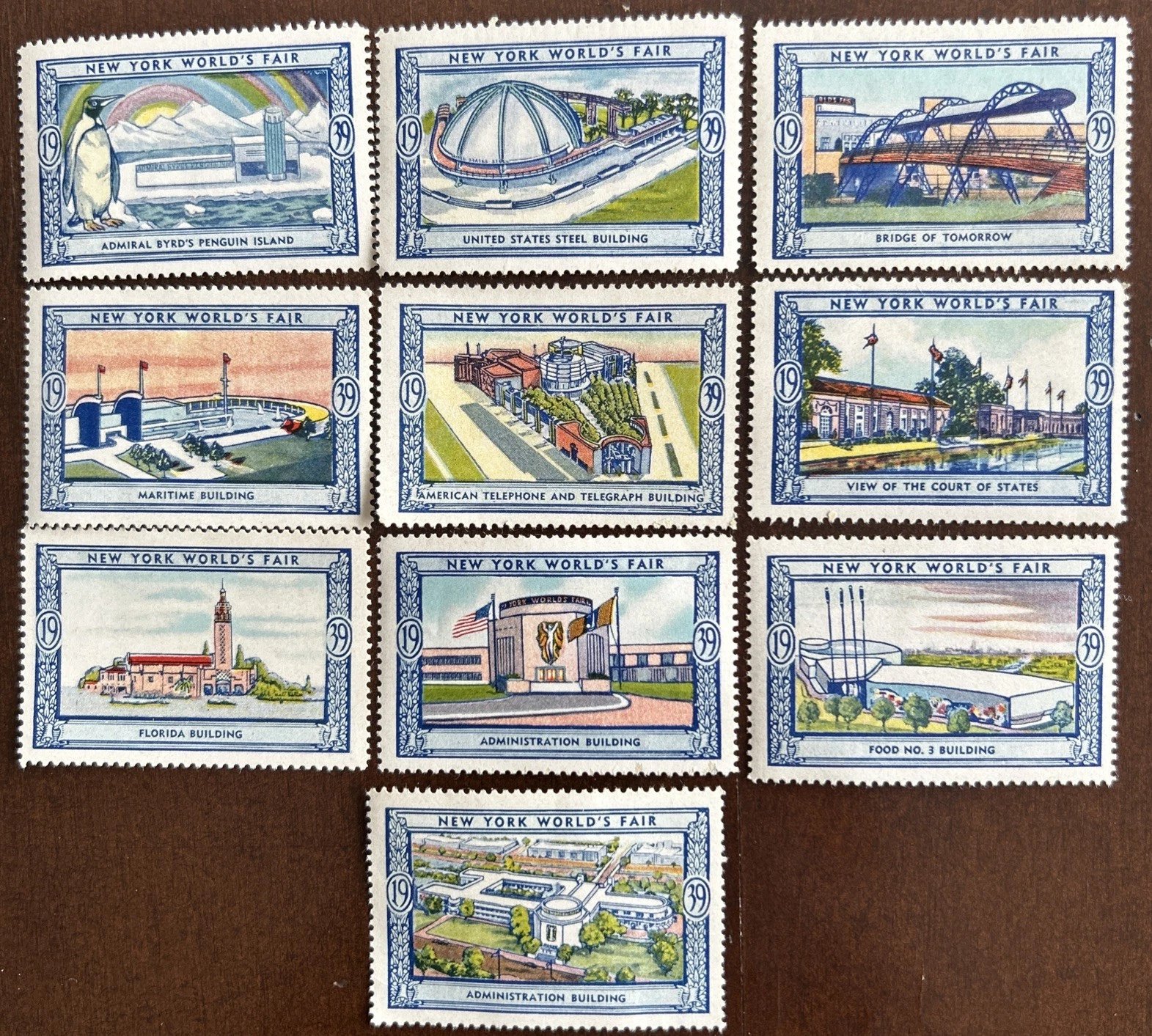
Charles’ first studio recording session was not with the sextet but with Lionel
Hampton and his band on September 11th for Victor Records. This was a star-studded affair with some of the top names in the jazz world: Benny Carter - alto sax and
arranger, Chu Berry - tenor sax, Coleman Hawkins - tenor sax, Ben Webster - tenor sax, Dizzy Gillespie - trumpet, Lionel Hampton-vibes, Clyde Hart - piano,
Milt Hinton - bass, Cozy Cole - drums, and, of course, Charlie Christian on guitar. Truly an all-star session.

Hampton RCA session # 1
(Sep 11, 1939)
Charles’ accompaniment on Hampton’s vocal “One
Sweet Letter from You” is divine and has never been equaled. The rhythm section assembled for this session is perfect, especially on the beautiful “When Lights
Are Low,” and should have been preserved intact – it rivals Count Basie’s rhythm section.

Jerry Newhouse
Informal recordings made on September 24, 1939 by Jerry Newhouse, a young man of 23 years who was in the printing-paper business in Minneapolis and a Goodman
and Roy Eldridge aficionado, captured the newly hired Christian while on the road with the sextet. Dick Richmond (a musician who knew Goodman’s tenor sax player
Jerry Jerome) and Jerry Newhouse (who had a Rek-O-Kut 12-inch turntable with Audax and Presto cutting heads at 78rpm) drove Christian and Jerome from the Orpheum Theater,
after a Goodman engagement, to the Harlem Breakfast Club, a private house converted into an after-hour joint. The club was located on a street that now longer exists,
where the Minneapolis Farmer’s Market and a freeway overpass now reside. This small district hosted at least two other clubs, all of which attracted the late night
crowd and regular raids by the “morals” squad. After one such raid, Oscar Pettiford was quoted in the paper as saying that all he ever saw being served there were
ham sandwiches.

Jerry Jerome
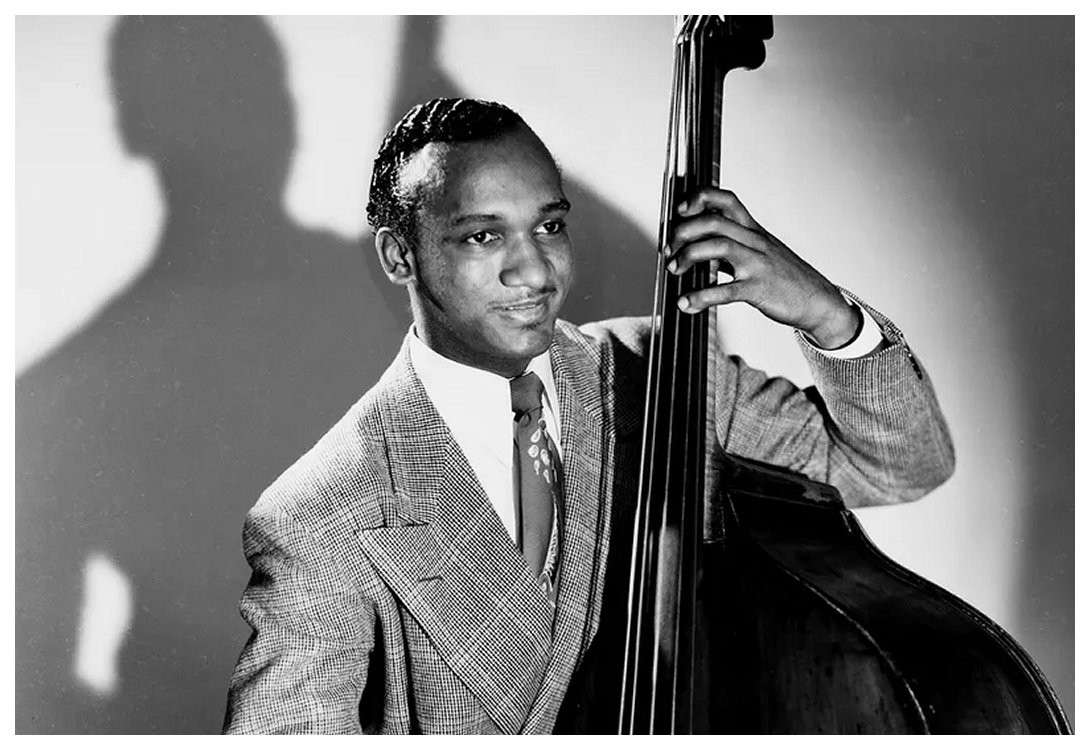 Oscar Pettiford
This impromptu session featured Charles, Jerry Jerome, pianist Frankie Hines and then-local bassist Oscar Pettiford. Since there was no drummer,
Charles was tapping out the rhythm with his foot. Newhouse had to set up the acetate disc recorder about twenty feet away in the adjoining room to keep the stylus
on track. Finally, they had to put a big, thick pillow under Charles’ foot. A hand-held mike was pointed at each soloist in turn. Taking multiple solos, Christian
showed much the same improvisational skills later captured on the Minton’s and Monroe’s recordings in 1941, suggesting that he had already matured as a musician.
The Minneapolis recordings (with the pillow in place during the entire recorded session) include “Star Dust,” “Tea for Two,” and two takes of “I Got Rhythm,” the
latter a favorite of bop composers and jammers.
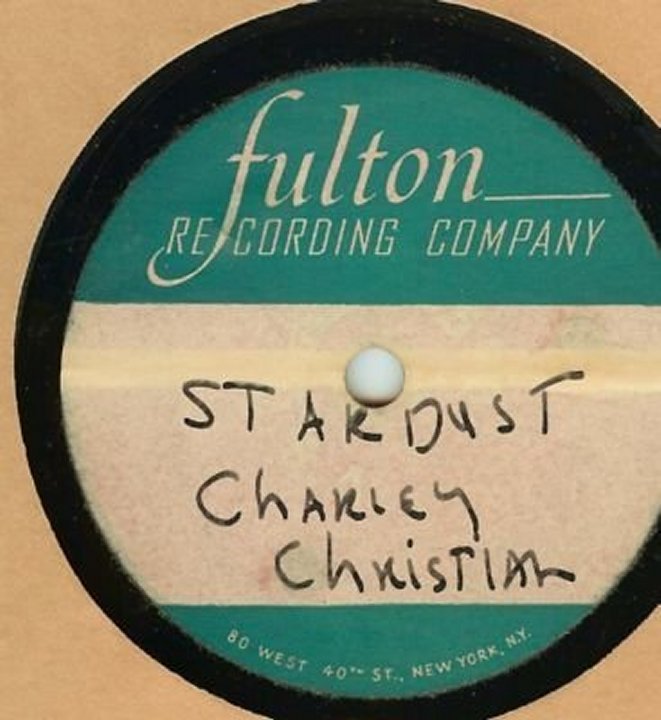
Newhouse’s Star Dust
acetate disc labelPettiford, who may have met Charles earlier at a place called Musician’s Rest, recalled “We had a wonderful time blowing with Charlie. I never heard anybody like that,
who could play like that, who could play with so much love – that’s what it was, pure love of jazz, and great happiness just to be a part of this thing called music.”
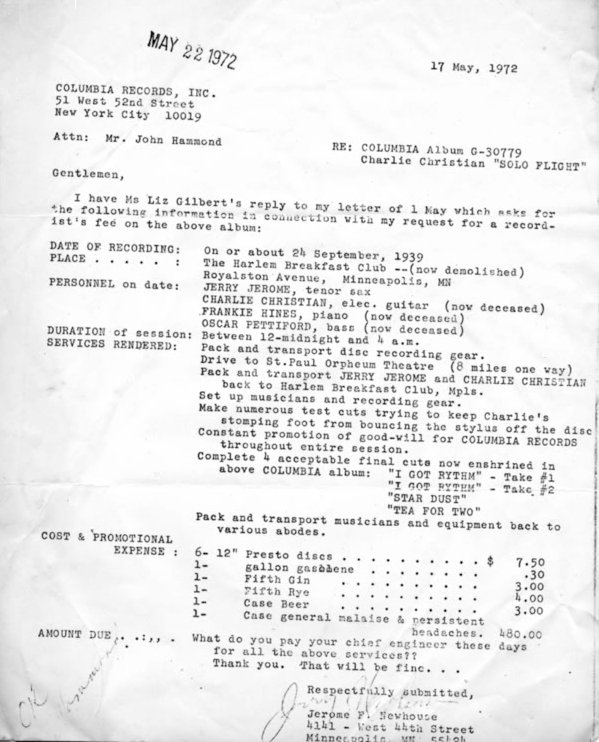
Jerry Newhouse’s bill to Columbia Records’ John Hammond
 Jerry Newhouse
Jerry Jerome, a fan of Lester Young, later said “Charles literally wrote music when he played solos…he was a very sweet, friendly, extremely creative musician
largely affected by Lester Young.” “Nothing fazed him musically,” Jerome recalls, pointing out that, aside from his fantastic soloing, “Charlie was a hell of a
rhythm guitarist – boy, could he make you play.” Craig McKinney says “Jerome believed, as some others claim, that Lester Young was an important influence on
Christian.” Craig states, “It should be remembered that Lester and Charles were part of the same regional culture,” but, Craig believes, “the saxophone that
Charles was hearing was the one in his head, not a copy of Lester’s.” A most astute observation.
Charles recorded his first studio session with the Goodman sextet on October 2nd – three tunes were recorded: “Flying Home” (the master and an alternate take
later released as “Homeward Bound”), “Rose Room” and “Star Dust.”
As a member of the improvisational combo, the Benny Goodman Sextet, Christian immediately became known among professional jazzmen for his new sounds and new
ideas. Only one other electric guitar had been recorded on jazz records when the first Christian-Goodman records were issued. After that, his large creative
contribution to modern jazz was widely recognized. Christian featured a down-stroke technique almost exclusively and usually used only two fingers of the left
hand on solos. His single-string solos, with altered chords, new melodic lines, rows of even beats, and contrasting dramatic aspects became the base from which
musicians constructed an entirely new approach to jazz. By the time of his passing, Charlie Christian had transported the music into another dimension.
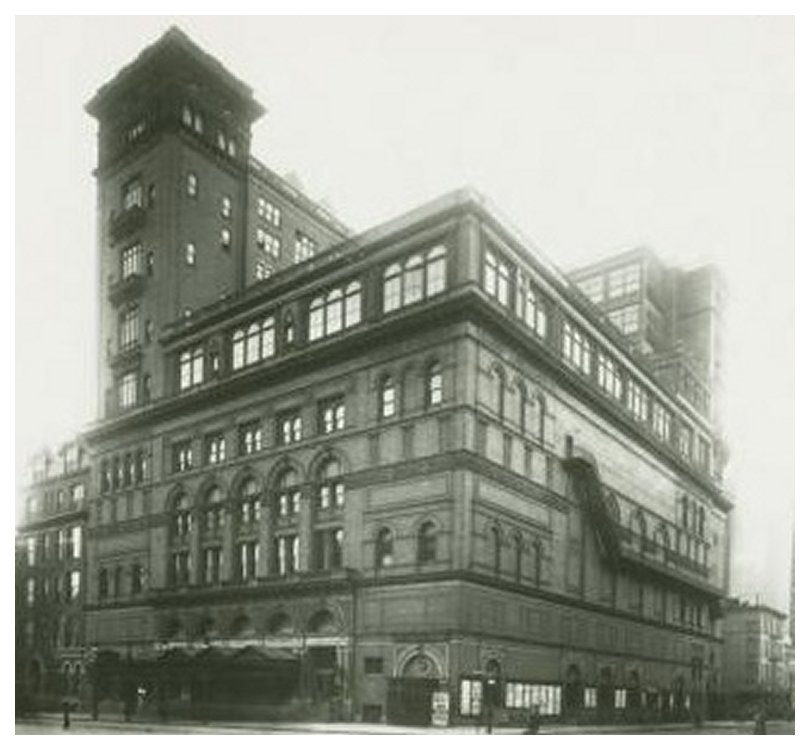
Carnegie Hall
On October 6, 1939, Charles and the sextet played played and recorded “Flying Home” and “Star Dust” at a Swing Concert for Mayor’s Music Week in Carnegie Hall to
celebrate ASCAP’s 25th Anniversary.

Hampton
RCA session # 2
(Oct 12, 1939)
That was followed by another studio session with Hampton and his band on October 12th
where he’s finally allowed some good solo time instead of just obbligati.
 Ida Cox AM recording session took place at
Liederkranz Hall
On the Halloween of 1939 he got to play more obbligatos backing vocalist Ida Cox on two
sessions for Vocalion – a morning session in Liederkranz Hall and another session later on Fifth Avenue.
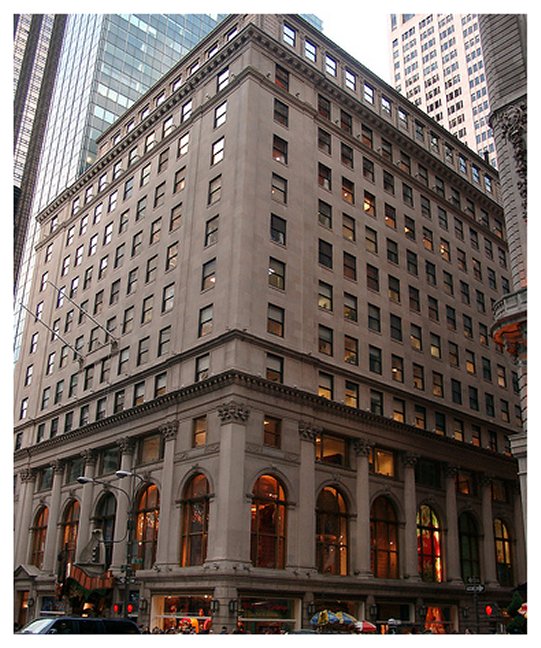
Columbia studios on Fifth Avenue, site of Ida Cox PM recording session.
There was a Columbia recording session on November 22nd that was particularly notable for Charles playing an extraordinarily beautiful, perfect chorus on
a Fletcher Henderson arrangement of “Honeysuckle Rose” over the whole Goodman orchestra. The sextet also recorded “Memories of You” and two of Charles’ own
compositions, the enchanting ballad “Soft Winds” and “Seven Come Eleven” both of which would be recorded later by others, especially the latter – often it was
the whole composition that was covered but even more frequently it was the “Seven Come Eleven” riffs that became part of many guitarists’ solos.
The sextet was engaged to play in a big musical “Swingin’ the Dream” which was a jazz adaptation of Shakespeare’s “Midsummer Nights Dream.” The show, which
included some of the biggest stars in the entertainment business, was highly publicized but highly criticized so it closed sooner than scheduled, only running
for 13 performances from November 29 through December 9, 1939 at the New York Center Theatre. The sextet’s feature for the show was “Flying Home” but it was
not recorded.
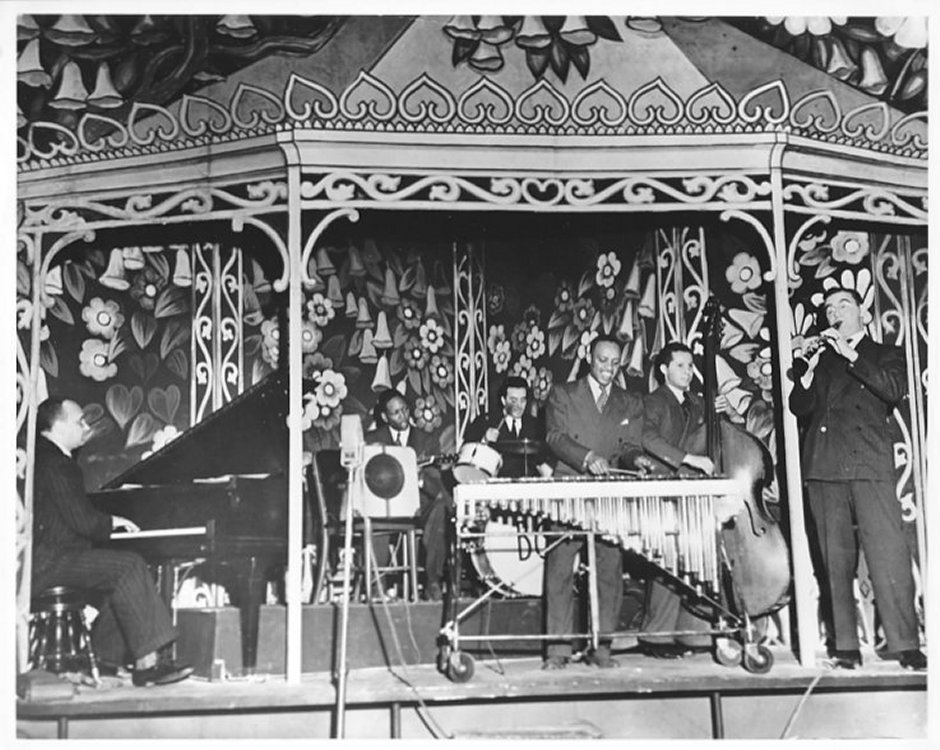
“Swingin’ the Dream”
In December 1939 the sextet played various continuing gigs in New York City during which time the intriguingly quaint Fletcher Henderson was replaced by the
highly talented Johnny Guarnieri as the group’s pianist.
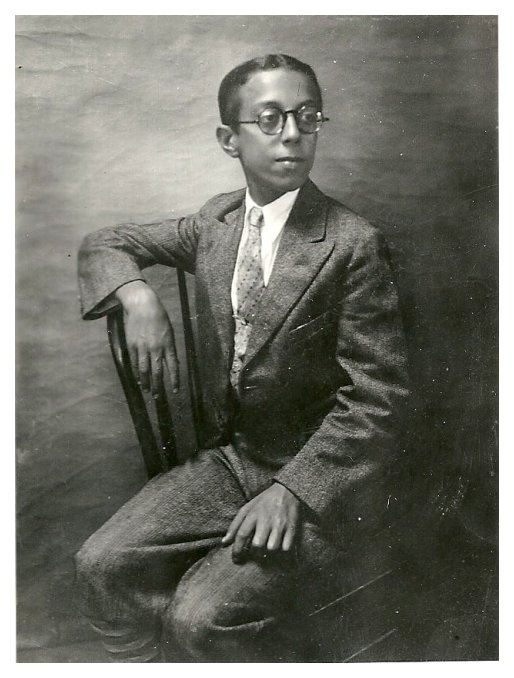
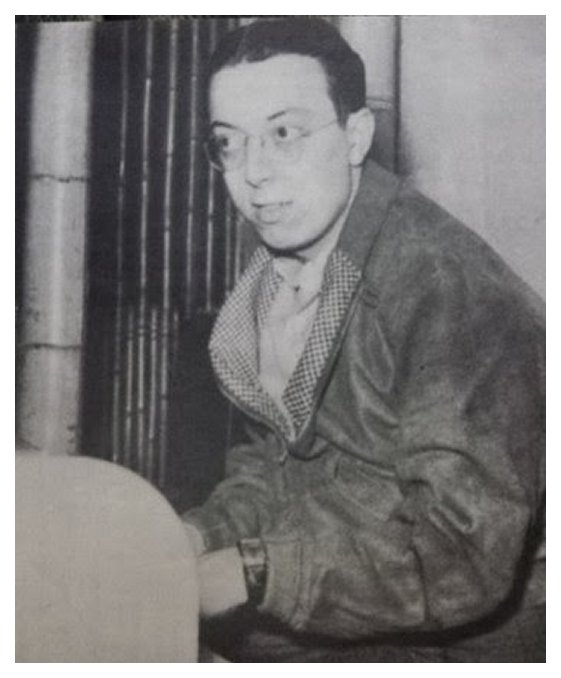
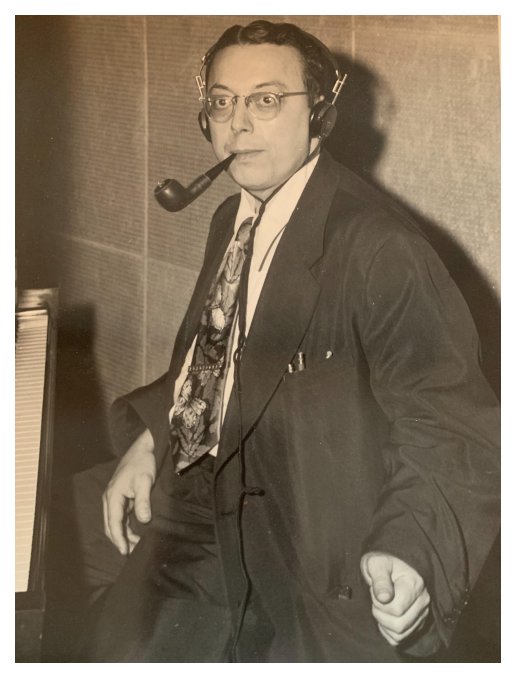
Johnny GuarnieriAlso about this time, Charles was already jamming at after-hours sessions…everywhere on any given night.
Then came the famed “From Spirituals to Swing” Concert at Carnegie Hall on Christmas Eve. A memorable event – Charles played three tunes (all with plenty of
solo time) with the Kansas City Six which included Lester Young and Freddie Green and, inexplicably, Christian solos on only three of five tunes by the Goodman
Sextet (with Fletcher Henderson temporarily back in the piano chair) – but those
three solos are gems. Charles is in top form this lovely evening.
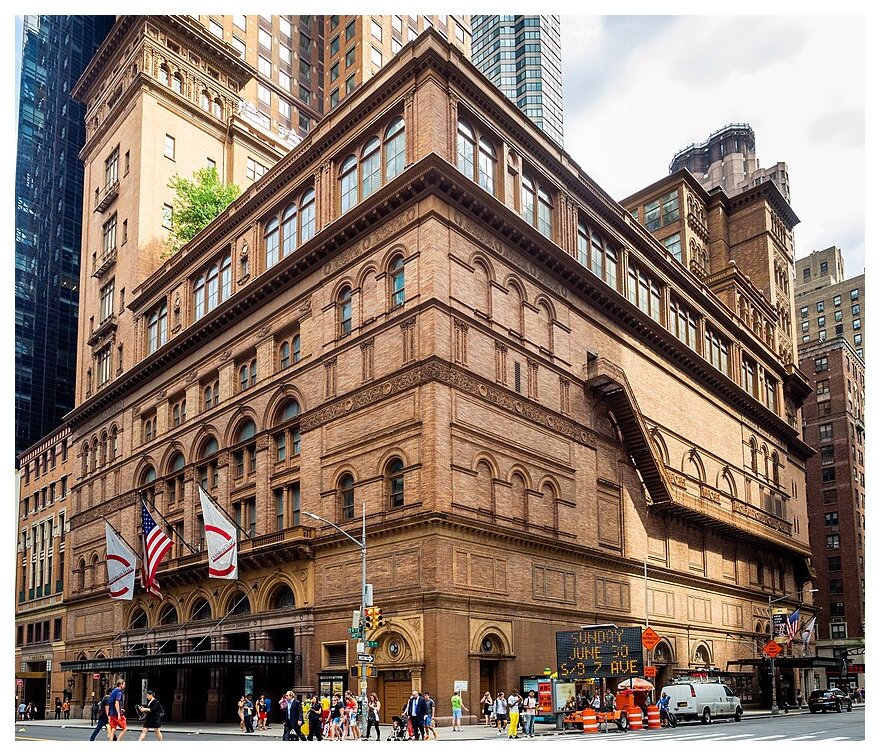
Carnegie Hall
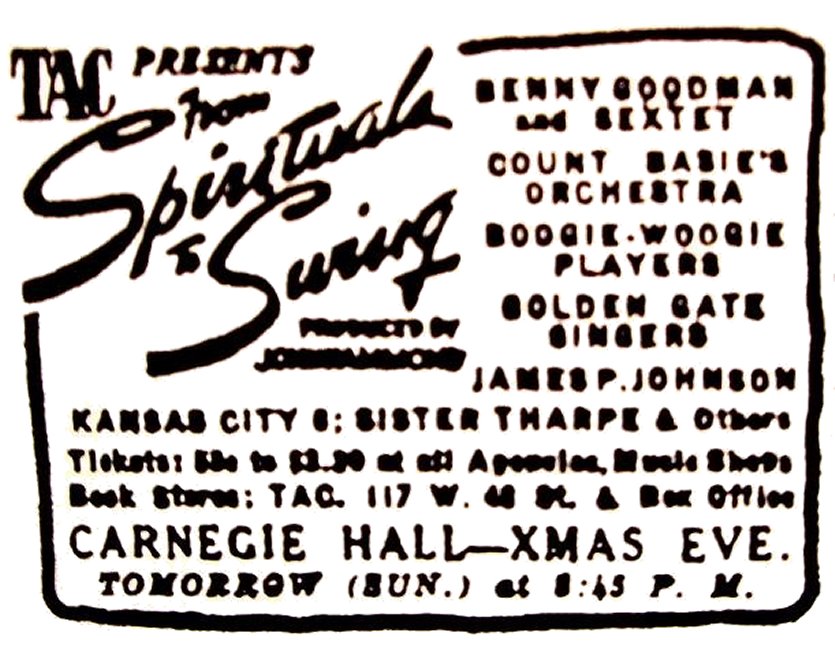 The finale of the 1939 “From Spirituals to Swing” concert was a wild affair with soloists from the Count Basie band and Benny Goodman sextet plus –six– piano
soloists on Oh, Lady Be Good which was taken at an almost frantic clip. At intervals, the full Basie band also joined in to provide orchestral fanfare. Charles
is favored with considerable solo space on “Oh, Lady Be Good,” far more than are any of the other plentiful contributors, on this 10½-minute romp. Each pianist
gets a one-chorus solo, Lester Young, Harry ‘Sweets’ Edison, and the bassist(!) Walter Page each get two choruses; Charlie Christian gets three wonderful choruses
plus the eight-bar bridge of the out chorus. The gods smiled upon us this day (beware: unfortunately, all LP releases and most CDs omit the third chorus of Charles’ solo).
During all this time, until the end
of 1939, the band was broadcasting on the “Camel Caravan” show every
Saturday evening on the NBC Radio Network and also playing at the
Waldorf-Astoria Hotel’s “Empire Room” three times a week.
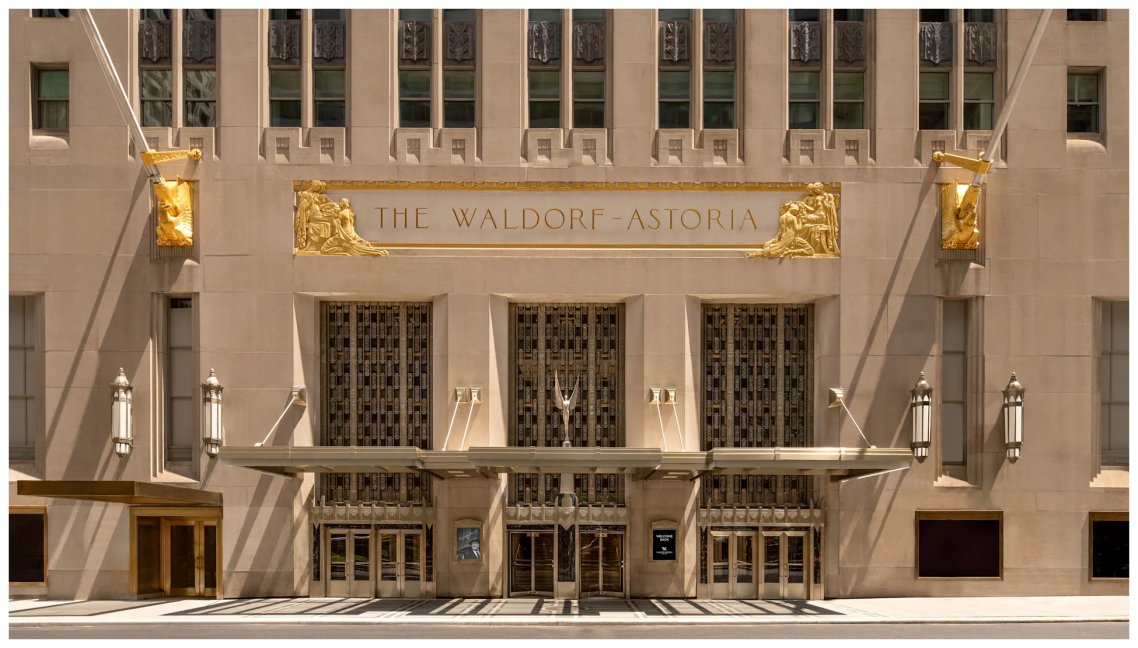
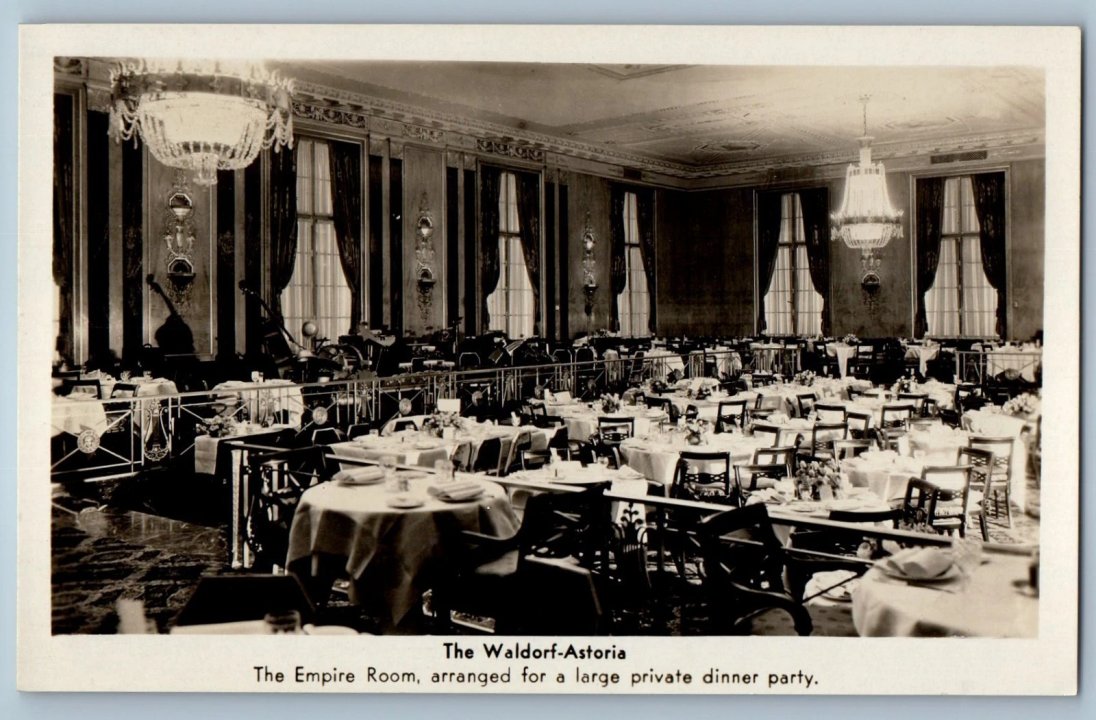
The Empire Room
Waldorf-Astoria Hotel (Mutual, CBS)
Many of these broadcasts had been recorded at the time by Jerry Newhouse (Camel Caravan)
and Bill Savory (Empire Room); they both continued recording other airchecks well into 1940.
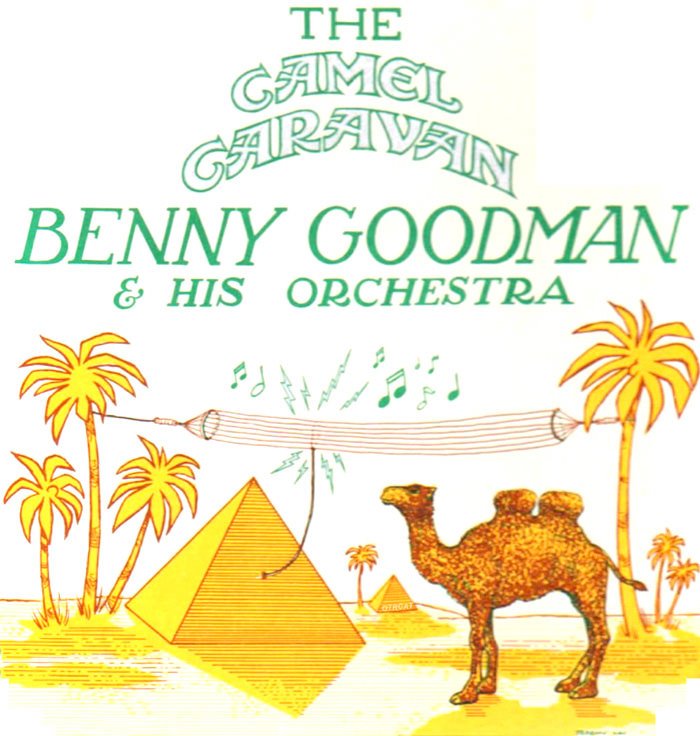 The Camel Caravan Show (NBC)
The final “Camel Caravan” show was broadcast on December 30. The next day, New Year’s Eve,
the sextet was featured on the “Fitch Bandwagon” radio show at the Waldorf and on New Year’s Day they began the year with a shortwave broadcast to Scandinavia.

Metronome All Stars recording sessionBy February 1940, Christian dominated the jazz and swing guitar polls and was elected to the Metronome All Stars. Colombia Records recorded two tunes by the
All Stars on February 7, 1940 then later on the same day, two tunes by the Goodman Sextet.
The band then had engagements in Pittsburgh, Indianapolis and in
Chicago where Charles fell ill and was hospitalized for exhaustion at Michael Reese Hospital where doctors discovered tuberculosis scars on his lungs.
It was not foreseen as anything fatal at the time.
 Michael Reese Hospital
 Just as Charles got out of the hospital, a two-week break was taken by the band due to various ailments of several
band members.
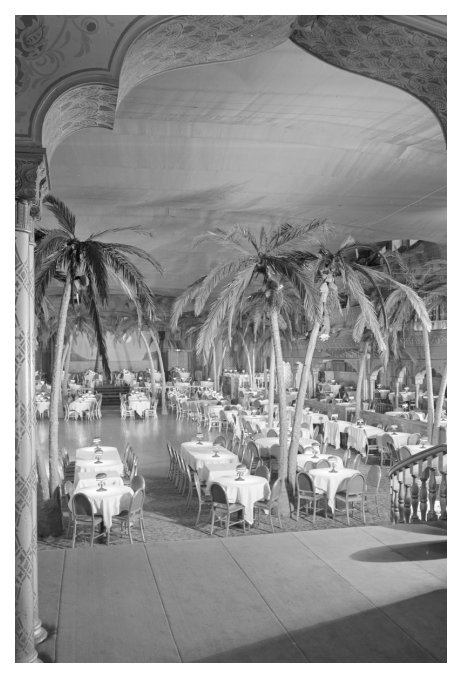
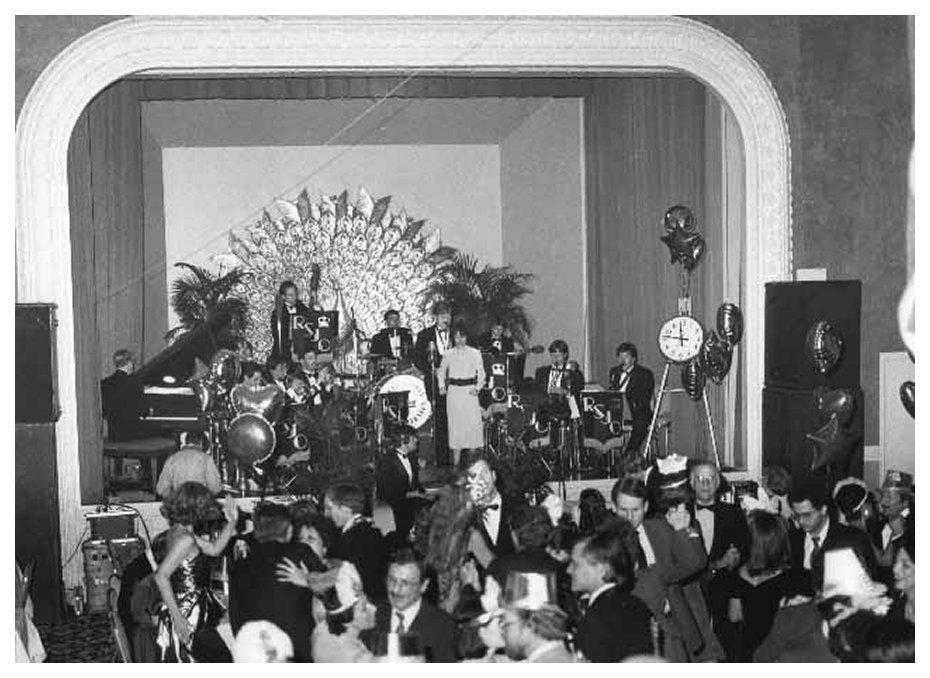
“The Cocoanut Grove”
“The Peacock Room”
Ambassador Hotel Mark Hopkins HotelMid-March the band was back on the West Coast with broadcasts from engagements at “The Cocoanut Grove” Ambassador Hotel, Los Angeles (March 19 through April 30
on Tuesdays, Fridays, Saturdays) and “The Peacock Room” Mark Hopkins Hotel, San Francisco (May 28 for a week or two). Between those two engagements there were
excursions to Phoenix and Tucson, to Seattle, Portland, Eugene, then to Vancouver in Canada.
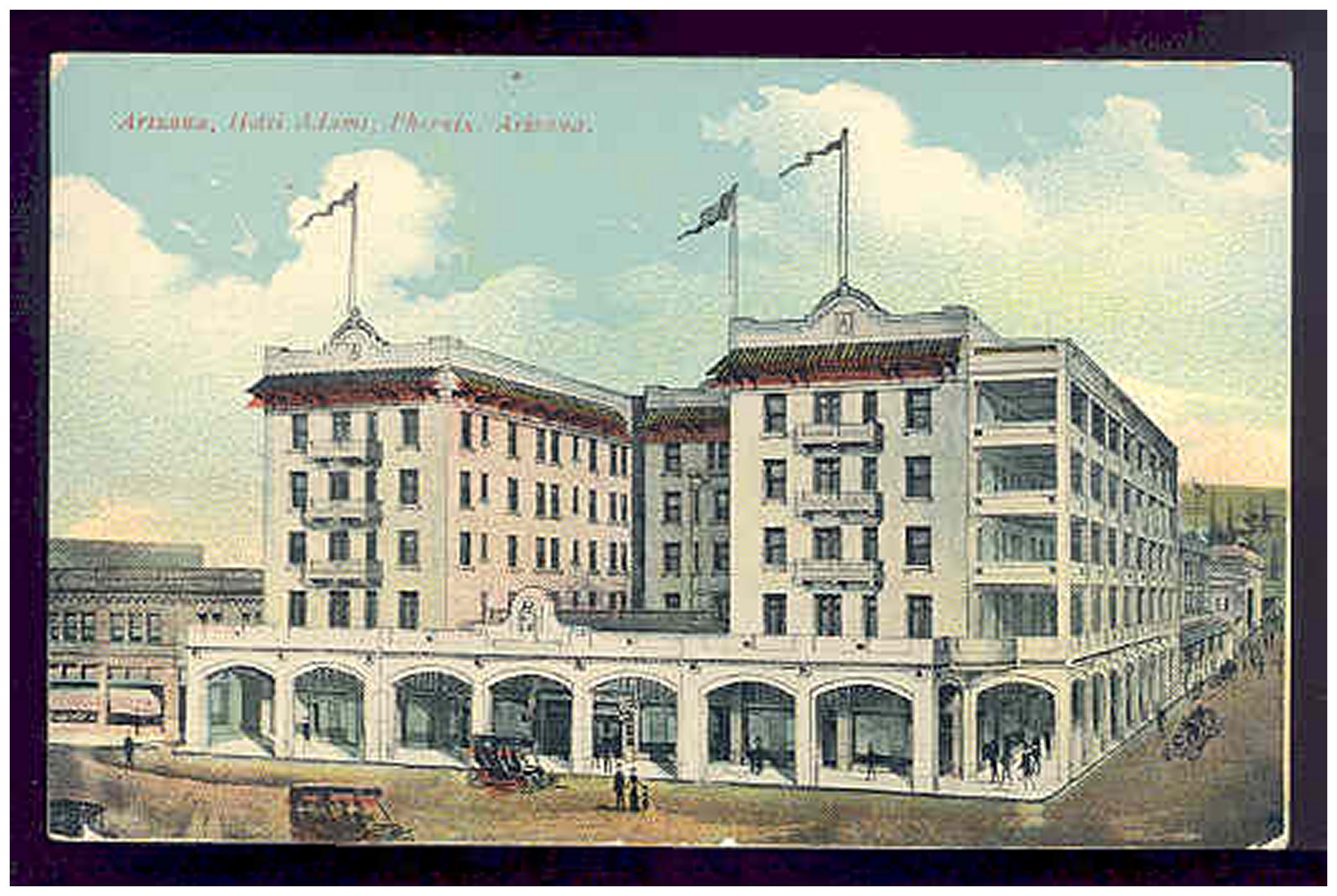 Hotel Adams, PhoenixAround this time Charles took over the guitar chair from Arnold
Covey in the band as well as remaining in the sextet.
The band’s stay on the West Coast gave Charles plenty of time (about
four months) to jam all along L.A.’s Central Avenue making a great
impact on the top talent in the area. Central Avenue was the new
heart of African-American Los Angeles. During the 1930s the African-American population of Los Angeles continued to climb, with most
newcomers settling in the Central Avenue vicinity. The 1940s was a
watershed decade for Central Avenue with the tremendous influx of
African American migrants during and after World War II – during the
war years, 50,000 newcomers settled in and around the Avenue, with
more arriving after the war. Central Avenue became famous for its role
in the development of West Coast Jazz. During the 1940s, gospel
trios and quartets gained popularity and had a major influence in
the development of Rhythm & Blues vocal groups.
Jazz clubs abounded on Central Avenue, from Little Tokyo to Watts,
and became the physical manifestation of jazz music. The Club
Alabam, the Apex Club, the Downbeat, the Flame and the Casablanca
are the names of some of these clubs. The origin of jazz in Los
Angeles has been attributed to a number of musicians who moved
there. Charlie Christian, Charles Mingus, Charlie Parker and Dizzy
Gillespie brought a new form of jazz – Bebop – from New York to Los
Angeles. Saunders King’s bass player Vernon Alley, later employed by
Lionel Hampton and Count Basie, recalls that Charles “was a giant –
a genius. People were astounded by him…no one could swing like
Charlie Christian did…Hampton thought he himself was the greatest
thing that ever happened, then here comes Charlie Christian.”

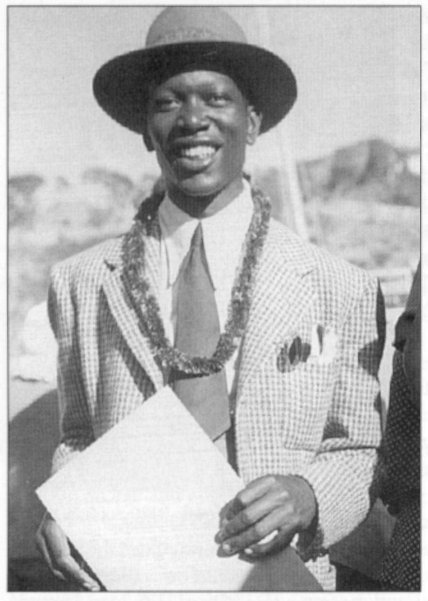
 The band settled in at Saint Catherine’s Hotel on Santa Catalina Island for what resulted in a curtailed month-long stay (June 15 through July 14). Jerry Jerome
recollected, “Charlie was quite a baseball player. The bands would have softball games with other bands, whoever was in the vicinity. We’d play them and the loser
would buy the beer…Having him in our team was immensely helpful and we rarely paid for the beer. We played the games around Catalina Island…Charlie was kinda slender,
very wiry – always smiling…everyone liked him, the wives kidded around with him. He was kinda shy, that kind of personality.”
While on the West Coast, the World Broadcasting System recorded the band for Columbia Records but the resulting recordings were not assigned their matrices until
about a week later thereby causing, for a time, some confusion in dating the tunes.
In the summer of 1940, Goodman had to have back surgery for sciatica and had to lay off most of his band, but he retained Charles and bassist Artie Bernstein.
Ziggy Elman and Kay Kaiser fronted the band for the last four nights on Catalina Island. Johnny Guarnieri, Jerry Jerome, and Nick Fatool, among some other band
members, went over to Artie Shaw’s band. Most unfortunate was that a motion picture with the band and the sextet was to have taken place right after the Catalina
Island engagement. That never happened.
Charlie Christian was kept on salary and he returned to Oklahoma
City in his 1940 Buick driven by his chauffer, Hillman ‘Little Pitt’
Pittman and accompanied by his secretary-valet-friend, Leslie
‘Spooks’ Sheffield, former bandleader and Charles’ former employer.
|
|
|
|
The Summer Break of 1940
According to his brother, ‘It,’ Charles usually visited with members of his OKC community the first days of his vacations – upper-class, middle-class, lower-,
rich or poor, everyone he knew in the neighborhood. “…regardless of his fame, he didn’t have the time to look down on nobody…he was very unselfish.” After that
self-ordained task was accomplished, Charles spent most of his time with his close-knit family. At times, he could be found in his room with the lights turned
down playing his guitar, often along with records of himself with the sextet. He would play continuingly different variations over the music. He always critiqued
himself and experimented with new ideas. Clarence Christian said that when Charles was home on a break from touring with Goodman, he listened to his own records
and said, “I should have played this,” and showed his brother the revised line on his guitar.
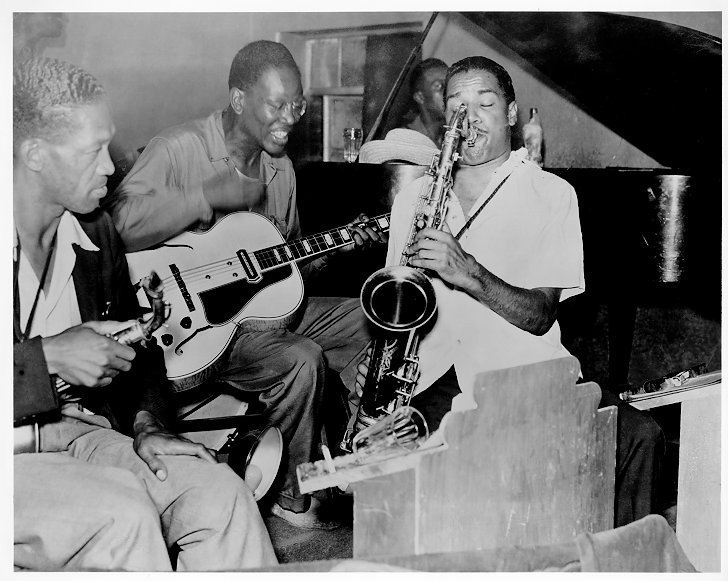
Jammin’ at Ruby’s Grill, OKC
September 7, 1940
News of his return to OKC preceded Charles, and various parties, dances, and jam sessions were set up for his welcome home. There was a lot of excitement and
activity going on in the town in anticipation. Charles participated in jams and, with his brother, Edward, gave a concert at Douglass High School. But there
was more time spent with his family and more leisure on this sojourn.
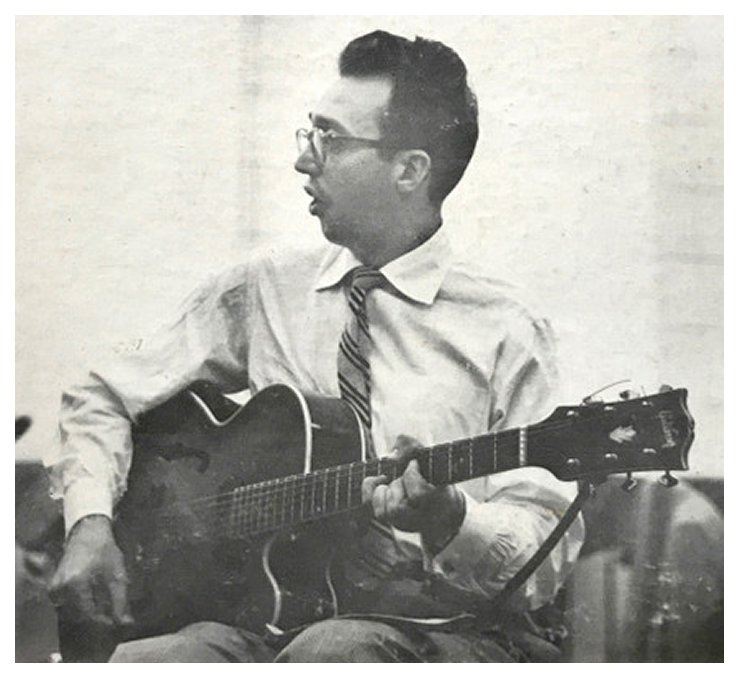 Barney Kessel
 A widely circulated published account of meetings between Charles and guitarist Barney Kessel
when the 17-year-old Kessel came to an Oklahoma Club in the white part of town occurred around this time.
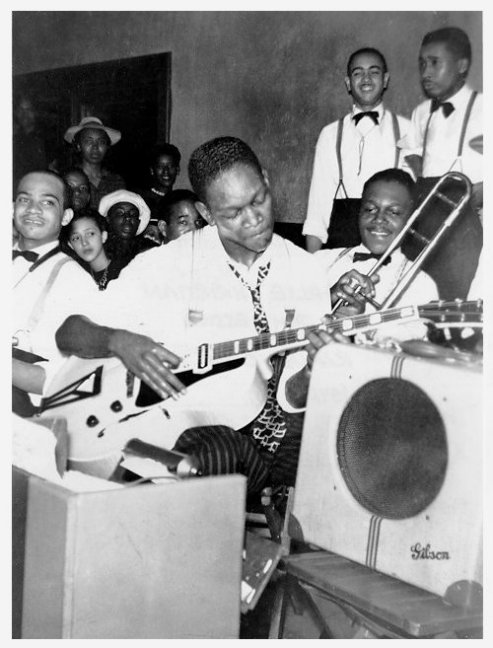 Sittin' in with Harlan Leonard's band, Kansas City
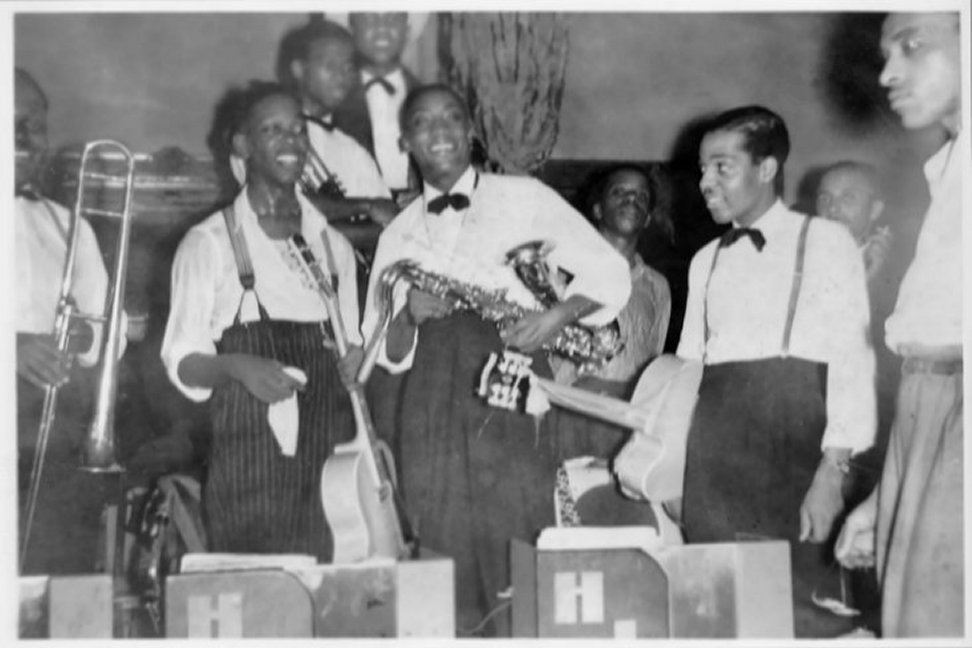 On his way back to New York City Charles was photographed on September 22nd sittin’ in with Harland Leonard’s band in Kansas City. He also went to a photo
studio in Kansas City to get professional pictures taken of himself while he was on leave.
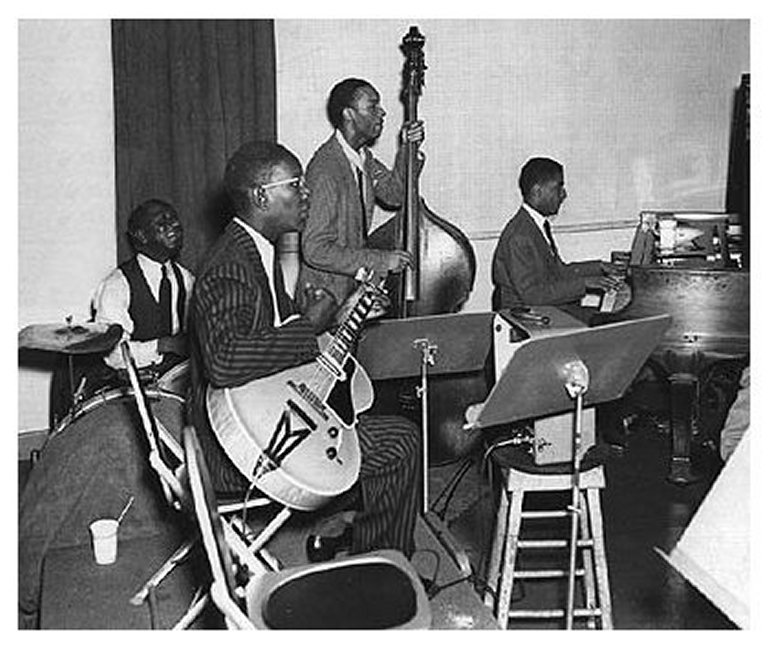 Eddy Howard session, October 4, 1940
 Back in NYC, Charles recorded at a October 4, 1940 session directed by Teddy Wilson backing pop singer Eddy Howard before he was recalled by Goodman.
Goodman had planned to return in August or September with Charlie Christian on guitar, Lester Young on tenor sax, Teddy Wilson on piano, Artie Bernstein on bass
but that was not to be. When he organized a sextet on his return, only Christian and Bernstein, both of whom he had kept on salary, were available. One of the first
events with his new bands was at a college prom on October 18 in Virginia and another a week later at Lehigh University.
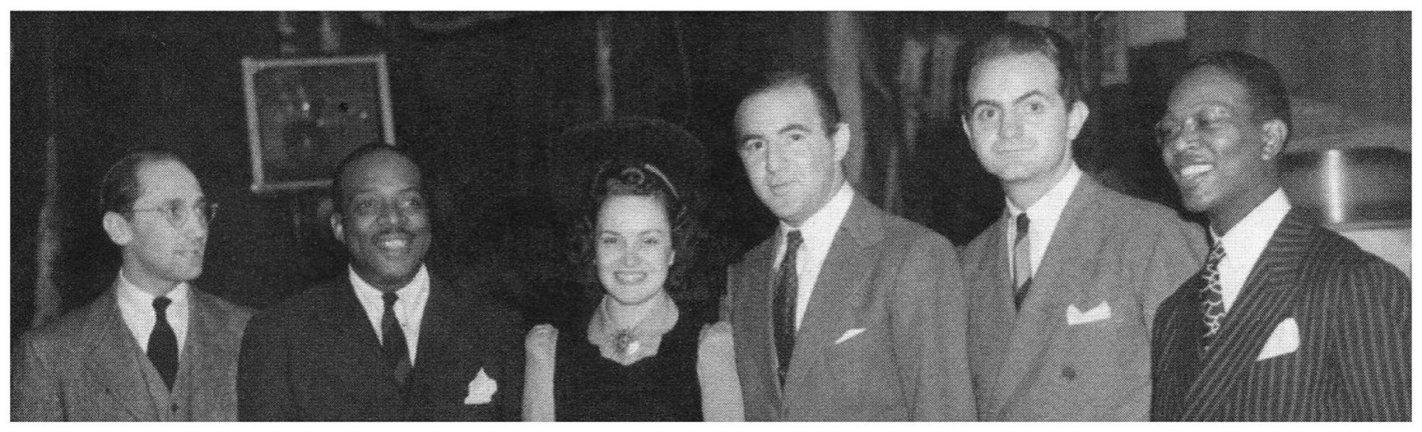
Backstage at the Apollo Theater on the 24th of October 1940
Interestingly, Charles and Benny sat in with
Count Basie and his orchestra at the Apollo Theater on the 24th of October.
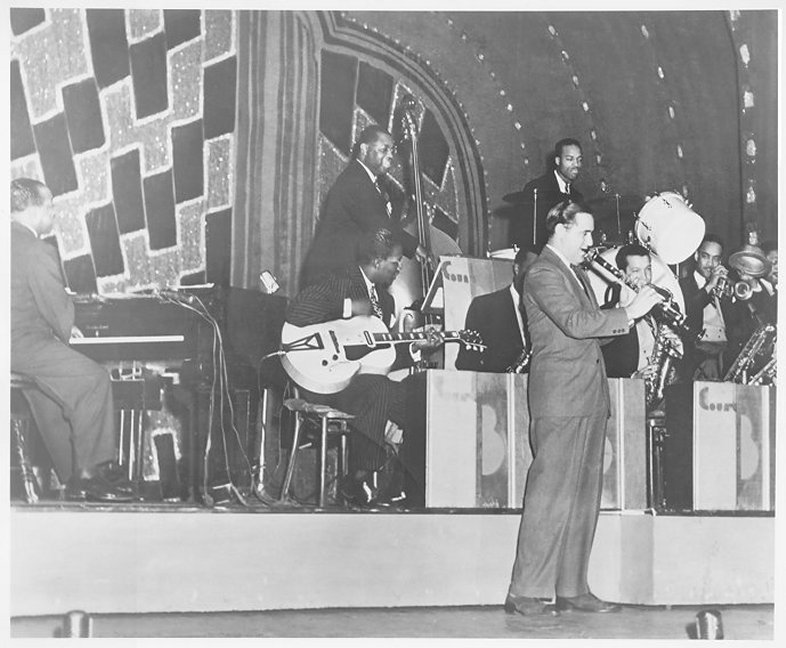
Charles
and Benny sittin’ in with Count Basie and his orchestra
at the Apollo Theater on the 24th of October 1940
There was a session held at Columbia’s recording studio on October 28, 1940 that included a stellar lineup including Charles, Lester Young, Goodman, trumpeter
Buck Clayton, Basie, Freddie Green, Walter Page, and drummer Jo Jones.
 October
28, 1940 October
28, 1940 Four tunes were recorded but none were released at the time. They were finally released by producer Jerry Valburn in 1973 on the Jazz Archives label, JA-6, “Charlie Christian / Lester Young – Together, 1940.”
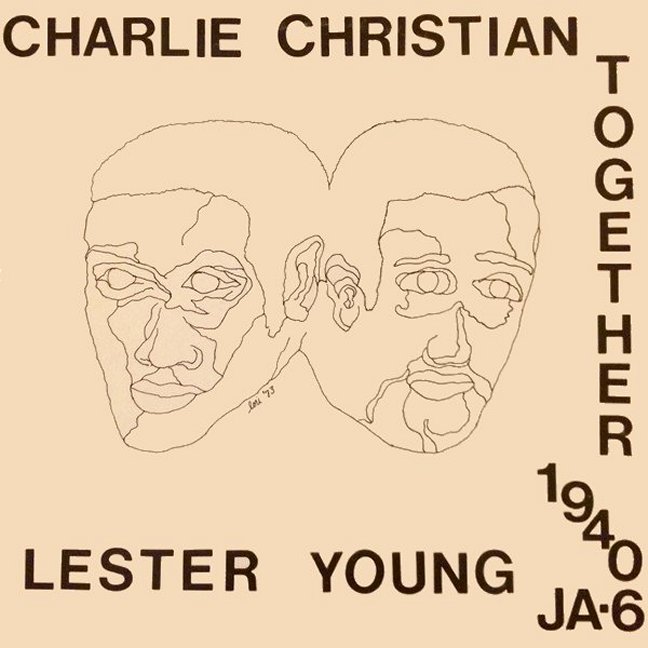
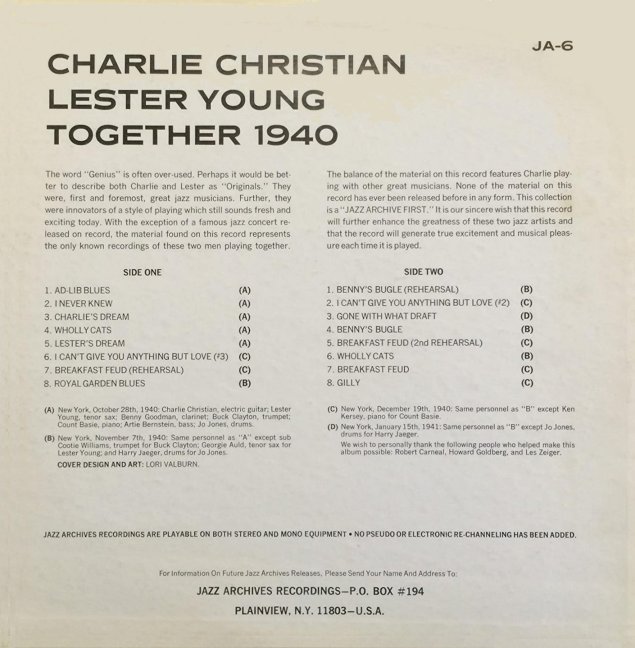
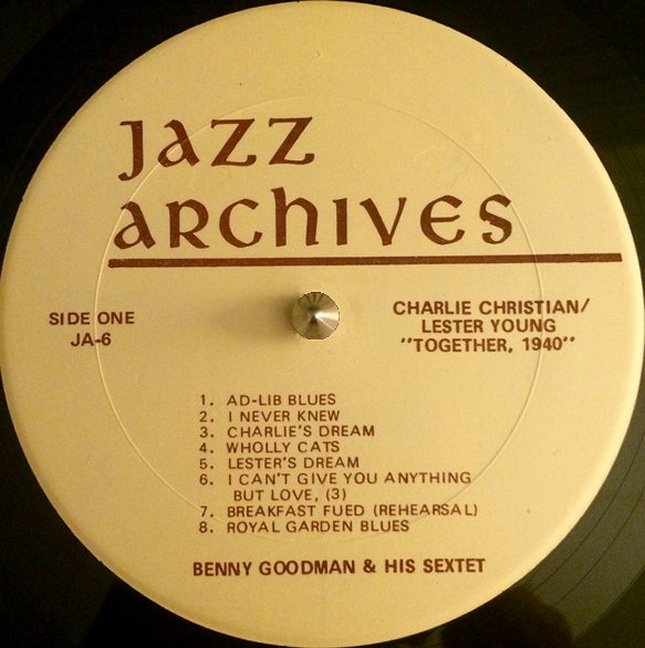
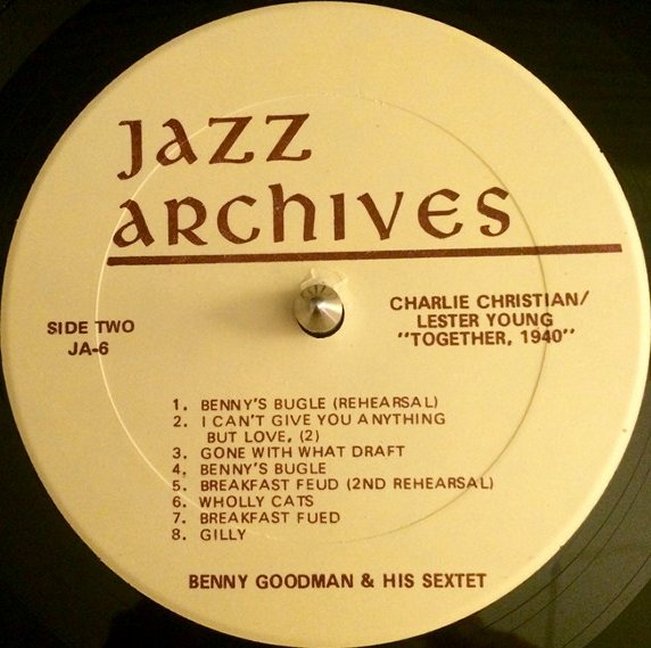
first five tracks are Charles & Lester at rehearsal, the remainder are
Charles on Columbia studio dates
Goodman may have organized this
as a rehearsal for a new sextet he may have hoped to recruit. Whatever the case, Goodman was only able to get Charles, who was already committed, Count Basie and
himself. Young may have slipped away from the new sextet but Goodman did put together one almost as good.
So in the fall of that
year Goodman led a septet with Christian, Count Basie, longtime Duke
Ellington trumpeter Cootie Williams, former Artie Shaw tenor
saxophonist Georgie Auld and, in early 1941, drummer Dave Tough
joined up. Johnny Guarnieri, who replaced Henderson in the first
sextet, filled the piano chair in Basie’s absence. The sextet was
now a septet – they went from the “Benny Goodman Sextet” to “Benny
Goodman and his Sextet.”
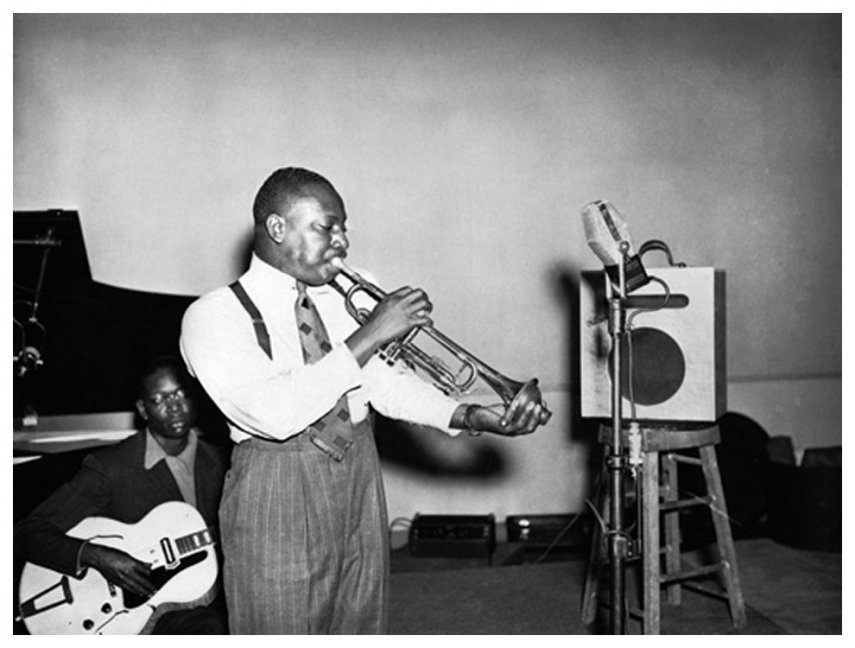 November 7, 1940 Columbia recording session November 7, 1940 Columbia recording session
Charles, Cootie, rare EH-275 amp; two were made by Gibson, one of which was given to Charles
The septet and band continued with engagements throughout north-east US and continued to record prolifically for Columbia Records the rest of 1940.
This all-star band dominated the jazz polls in 1941, including
another election to the Metronome All Stars for Christian. He won
both the Down Beat and the Metronome polls for Best Jazz Guitarist
from 1939 through 1941.
As boys, Charles and his brother ‘It’ went to the movies when they could find the money. Their favorite actors included George Raft, Bette Davis, and
Edward G. Robinson. As ‘It’ recollected to his interviewer McKinney that Charles had told his brother that he was sitting up front next to the footlights,
the band started playing and as the curtain went up he said, “I like to fell out of the chair…George Raft was standing right there in front of me with his arm
around Betty Davis. I like to swallow my tongue. I shut my eyes just as quick as I could and I played the whole rest of the show with my eyes shut. I got to
thinking how hard we used to scuffle to get 15 cents to see them in the movies, and there they was paying a hundred dollars a plate to come and hear me play!”
Charles and Bette Davis later became friends and mutual admirers.

Mary Lou Williams Charles and Mary Lou Williams would meet in the basement of Harlem’s Dewey Square Hotel to work on music – playing, composing, writing or just jamming together
during this imprecise period of December 1940. Then came the infamous recording session of December 19, 1940 which produced five takes of “Breakfast Feud” three of which were subsequently spliced with other takes including those
from the session of January 15, 1941. The splicing practice was initiated by Columbia producer Chris Albertson when he spiced together tracks of Charles’ solos
for the April 1955 release of the first CC 12" record album, Columbia CL 652, Charlie Christian with the Benny Goodman Sextet and Orchestra.
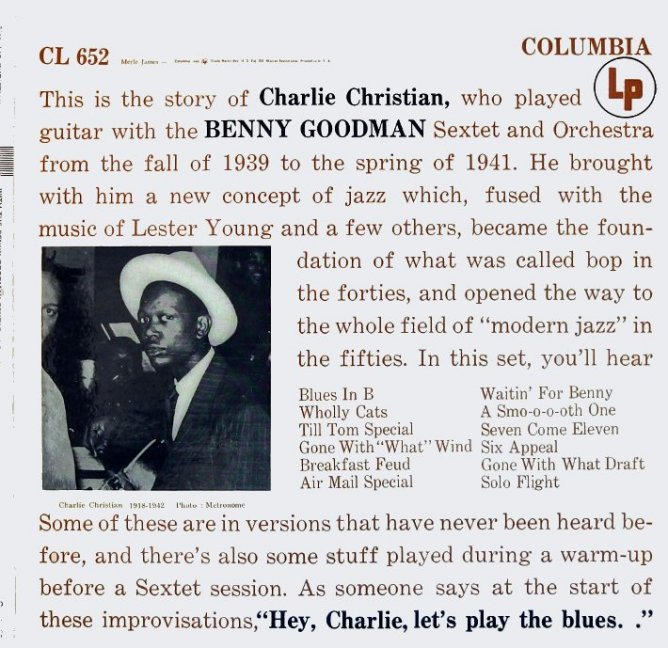
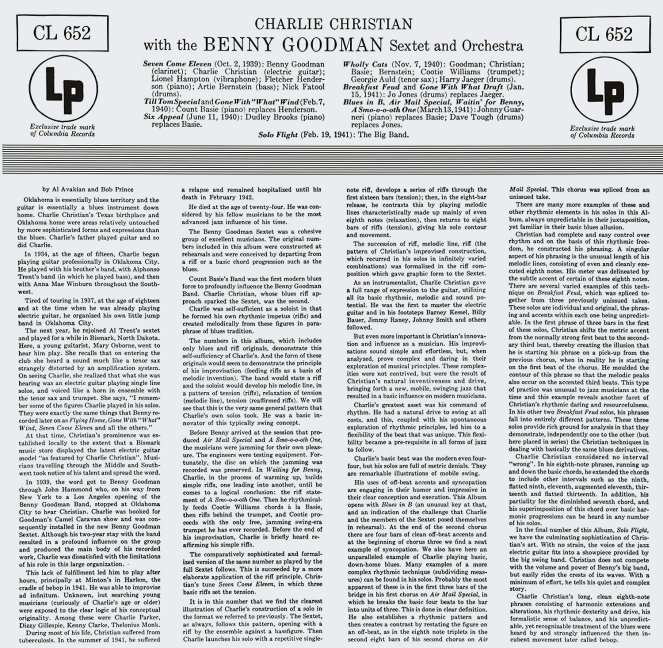
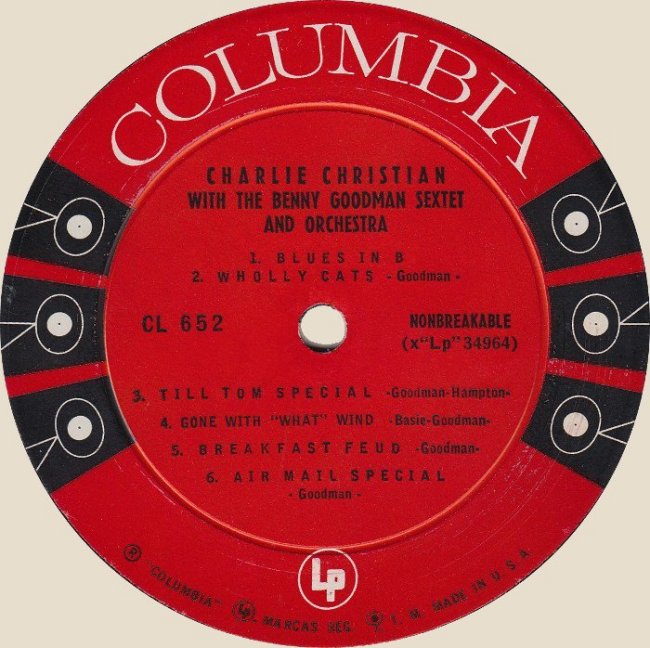
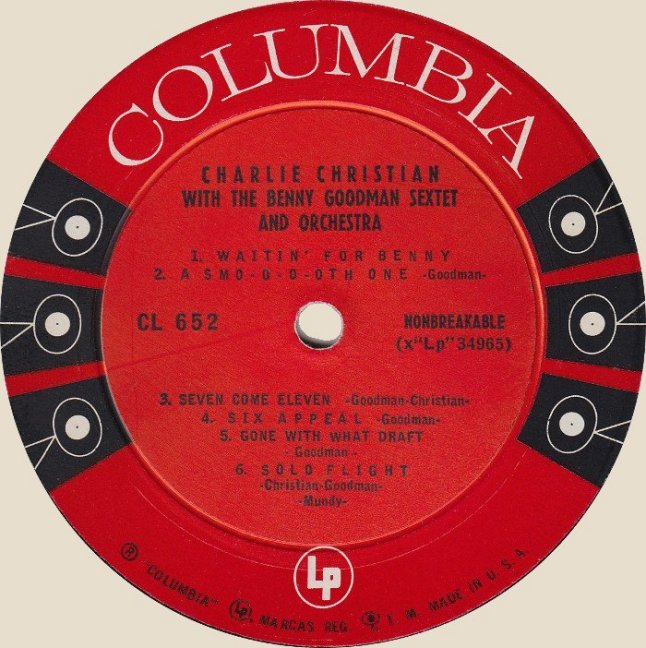
The session on January 15,
1941 produced two more “Breakfast Feud” takes that were spliced with other takes in the CL 652 album. The session also produced another tune “Good Enough to Keep”
that contributed tracks from alternate takes for the Albertson album. The practice of splicing Charles’ solos tracks together continued well into the CD era. The
mysteries weren’t completely solved until 1981 with the transcription of the tunes.
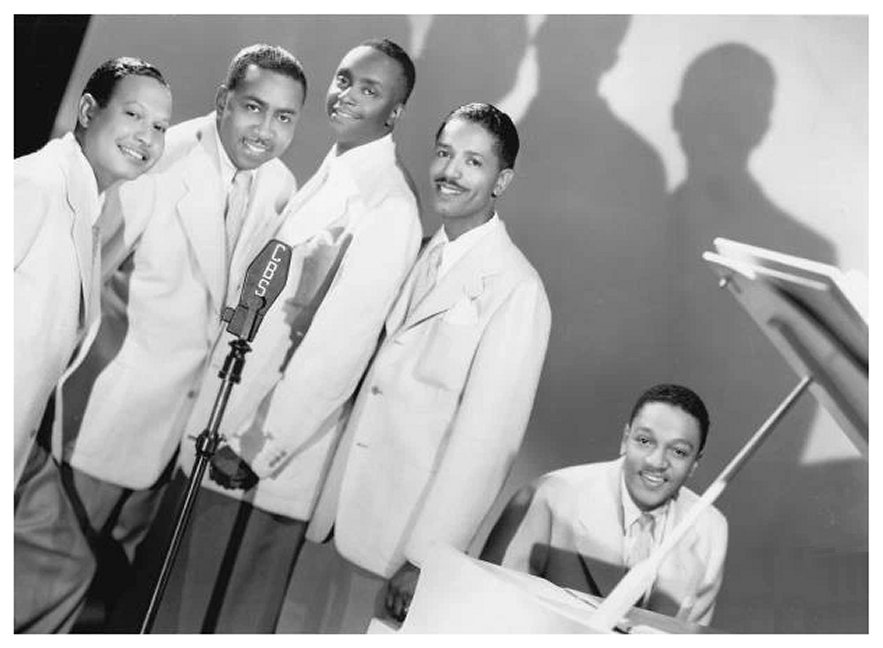
The Charioteers:
Edward Jackson
(second tenor), Ira Williams (baritone), Billy Williams (lead
tenor), Howard Daniel (bass), Jimmy Sherman (piano)
On January 16, 1941 during a break in the septet’s long Columbia recording session Charles and Jo Jones joined pianist James Sherman and bassist Walter Page
to provide accompaniment for The Charioteers vocal group at the same studio.
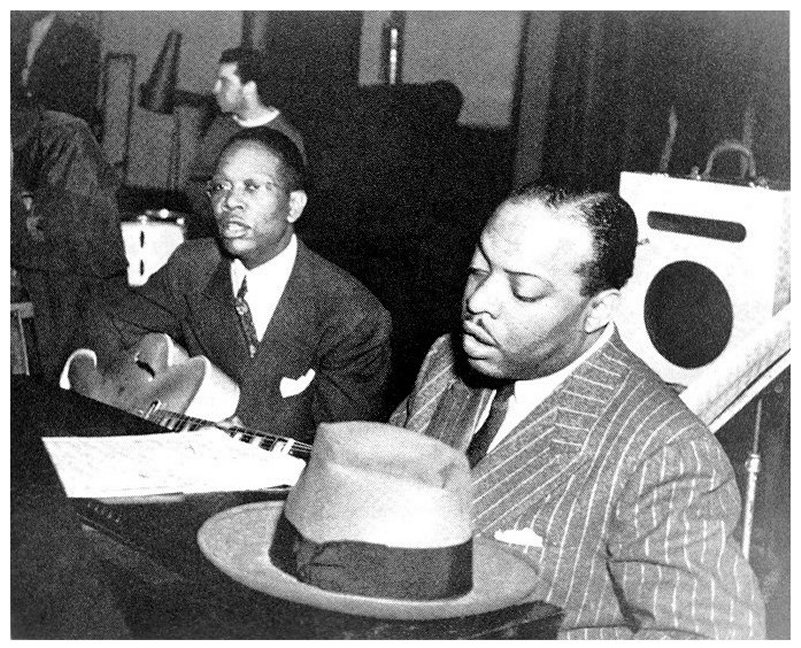 Metronome
All Stars - January 16, 1941 Metronome
All Stars - January 16, 1941 Later the same day, as one of Metronome’s 1941 poll-winning All Stars, Charles and
four others from his septet recorded two tunes, this time for Victor Records.
Charles had won both Metronome’s and Down Beat’s “Best Guitarist” of the
year, overwhelmingly...again. Two weeks later at the “President’s Birthday Ball” in Washington, DC, Charlie Christian
met and shook hands with President Franklin D. Roosevelt.

Charles with Gibson L5N acoustic guitar
February 5, 1941
The celebrated “Profoundly Blue” recording session with the Edmond Hall Celeste Quartet for Blue Note Records
took place on February 5, 1941 at Reeves Sound in Manhattan. It was one of the very first releases on the Blue Note label.

“Profoundly
Blue” recording session - February 5, 1941
Charles on Gibson L5N acoustic guitar
The personnel on this date were Charles on
acoustic guitar; Edmond Hall, clarinet; Meade Lux Lewis, celeste; Israel Crosby, bass. In spite of the extremely annoying celeste, Charles’ solos were near perfect,
especially on the “title” tune. His interaction with Crosby was excitingly excellent. His rhythm on the boogie riffs was extraordinary – perfect coordination.
The Goodman band started a new broadcasting contract for yet another cigarette company on February 18, 1941. “What’s New? – The Old Gold Show” went on the air
every Monday on NBC Radio Network (local New York City jazz radio station WJZ) for 13 weeks lasting until May 5, 1941.
The band was on the “Fitch Bandwagon” radio show again, on NBC, Sunday, February 16 and appeared on “America in Swingtime” where the sextet recorded six numbers
at the second annual American Music Festival, February 19, 1941 broadcast on radio station WNYC for the Municipal Broadcasting System. The entire aircheck was
re-broadcast on October 3, 2012 for the first time since the original broadcast.
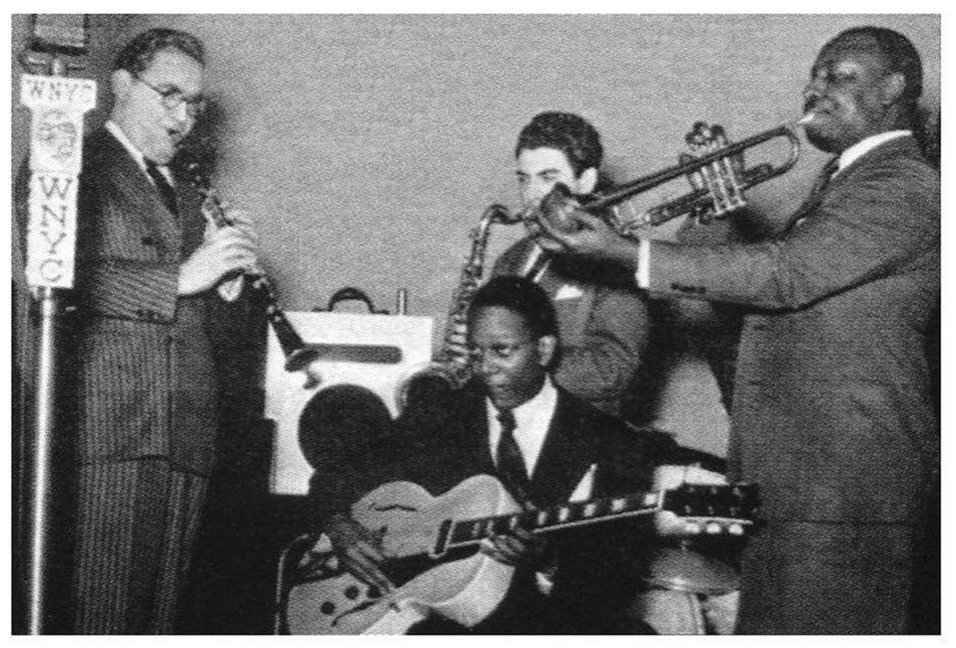 “America
in Swingtime” - February 19, 1941 “America
in Swingtime” - February 19, 1941 The Charlie Christian/Jimmy Mundy composition and future big hit “Solo Flight ” by Charles and the full orchestra was broadcast on the Old Gold Show on March
3rd and the next day recorded at the Columbia studio. One can only imagine Charles’ thoughts and emotions hearing his own creation backed by a full-sounding
orchestra. This guitar concerto was finally released on 78-rpm in December 1943 rising all the way to # 1 on Billboard’s Harlem Hit Parade in March 1944, two
years after Charlie Christian had passed. The alternate take was released on LP in 1955.
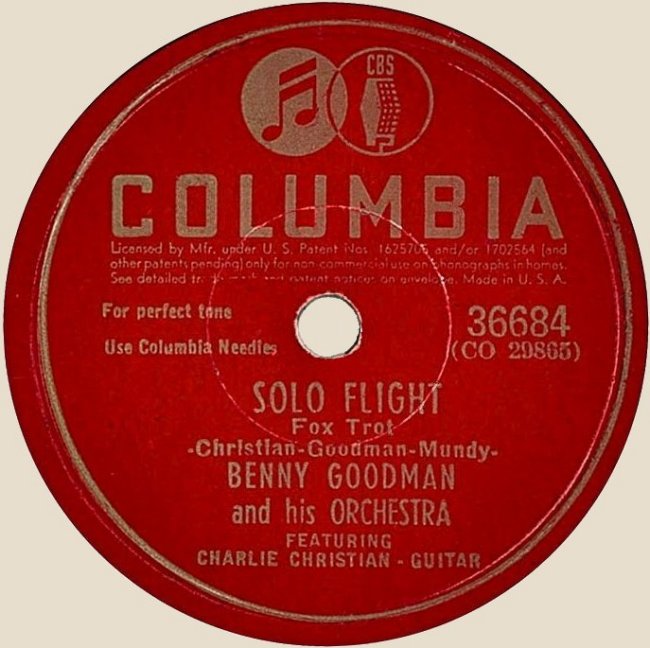
Solo Flight
recorded March 4, 1941
released December 10, 1943
# 1 on Billboard’s Harlem Hit Parade in March 1944 A routine Columbia recording session scheduled for March 13, 1941 turned out to be one of the most extraordinary and fortunate events in the annals of
jazz. Goodman and Bernstein were late for the session and Charles, Georgie Auld, Cootie Williams, Johnny Guarnieri, Dave Tough were in the studio warming
up. The engineers were testing and calibrating their recording equipment. Charles, as usual, was improvising and noodling around with one tune or another
with the other musicians joining in and dropping out of Charles inventive waves of music. It quickly turned into a jam that the insightful engineers were
resourceful and quick-witted enough to capture on their sound recorders.
Charlie Christian was experimenting and inventing the most heavenly sounds that no one could ever imagine. This went on for over 21 minutes almost uninterrupted
with Charles only meandering off for a moment or two, or briefly accompanying the others on rhythm guitar. These precious recordings give the fortunate
listener an insight into Charles’ genius that even the Minton’s/Monroe’s jams don’t quite provide. Blessed be those Columbia sound engineers. The captured jam
session started with 7:08 minutes of free improvisation that was appropriately titled “Waitin’ for Benny” when it was partially released on LP in 1955; the last
tune in the pre-rehearsal jam was played in the key of B and issued on the same LP entitled “Blues in B.” The sequence of the entire recorded jam was
free
improvisation titled Waitin’ for Benny/I Can’t Believe…/Rose Room/I Hadn’t Anyone…/Blues in B.
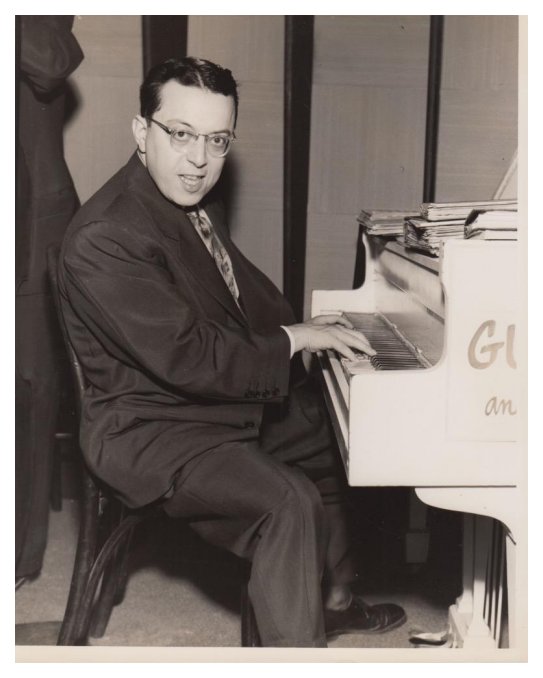
Charlie, Charlie, Let’s play the Blues…in B Later, after Benny and Artie arrived and the actual recording session officially started, the last half of the Waitin’ improvisation was worked on to become
a proper tune. It was named “Moppin’ It Up” later re-titled “A Smo-o-o-oth One” for release on the same 78rpm record as the only other commercial recording that
day “Good Enough to Keep” – on the second pressing of the latter the title was changed to “Airmail Special” and reissued with the same catalog number.
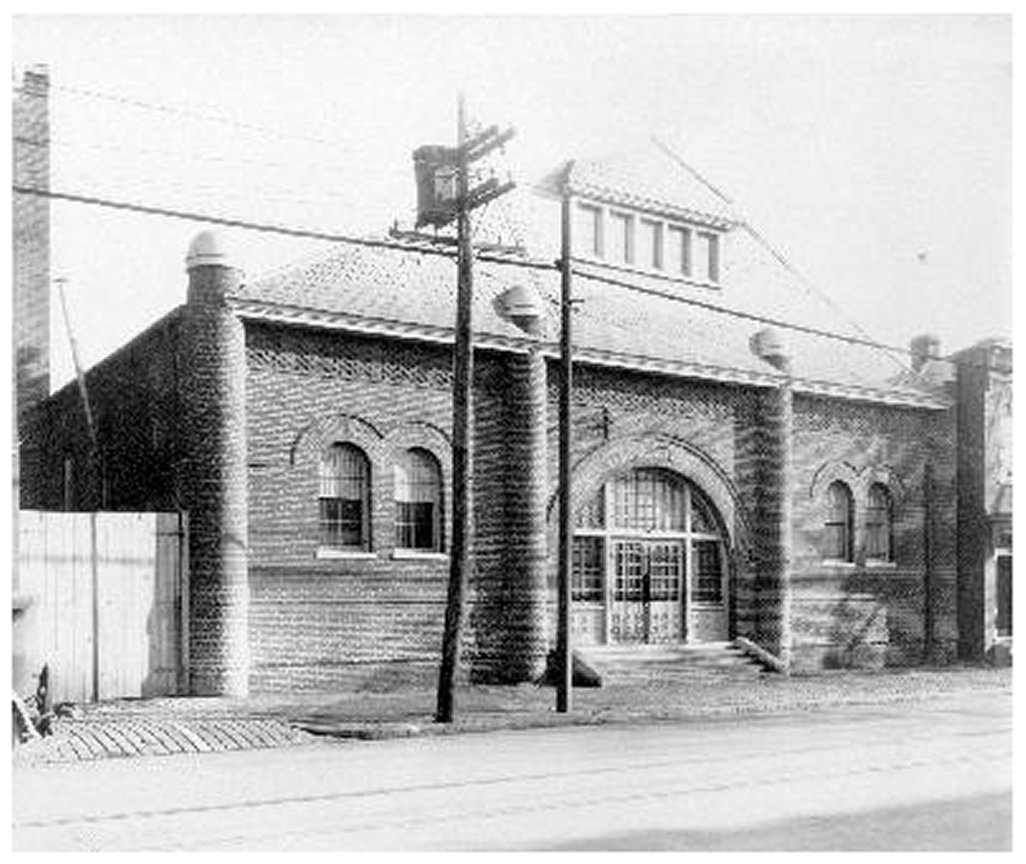
Armory in Alexandria, Virginia
“Shenandoah Apple Blossom Festival” “A Smo-o-o-oth One” was still called “Moppin’ It Up” when the septet played the tune at the 18th Annual “Shenandoah Apple Blossom Festival” at the Armory in
Alexandria, Virginia on May 1, 1941 (it was recoded but was never released – it remains ensconced at the Rutgers Institute of Jazz Studies in Newark). The commercial
version that had been recorded earlier was released on Columbia Records two days after the festival with its new and official name.
All during this time, the band continued appearing on the Old Gold Show, until the final show on May 5, emanating from Manhattan Center and recorded at the
studio at Columbia Records, also in Manhattan.
Charlie Christian was captured on acetate jamming at Minton’s and Monroe’s in Harlem during May. (see below)
On May 18, 1941 took a one-week break before returning to begin a new series of radio shows called the “Monte Proser Dance Carnival” broadcasting from Madison
Square Garden and sharing the stage with the bands of Charlie Barnett and Larry Clinton. This affair was carried on the Mutual Broadcasting System well through
most of June during which time there was a lot of goings on with personnel in and out of the band.

“Monte Proser Dance Carnival”
broadcasting from Madison Square Garden Guitarist Al Viola recalls, “Most of the time I saw Charlie he had that small ES-150 with the small amp. The only time I saw him with the piggy-back, was at
Madison Square Garden, the Monte Proser thing. He used a blonde ES-250 …his amplifier was a piggy-back, an EH-275. The tuner was detached from the speaker. His
sols were clean and the greatest jazz lines I have ever heard, by anyone, even today. A genius! Charlie left me spellbound.”


Cedar Point Ballroom It was around June 15th during at an engagement at the Cedar Point Ballroom on Lake Erie in Sandusky, Ohio that Charles fell ill and was rushed to the hospital. He would
never return. Tommy Morganelli replaced him on the band’s rhythm guitar chair. The sextet was no more.
Charles’ work on the Goodman sextet sides “Soft Winds,” “Till Tom Special” and “A Smo-o-o-oth One” show his use of well-placed melodic notes. His work on the
Sextet’s recordings of the ballads “Star Dust,” “Memories of You,” “Poor Butterfly,” “I Surrender Dear” and “On the Alamo” and his work on “Profoundly Blue” with
the Edmond Hall Celeste Quartet in1941 show hints of what was later called cool jazz.
Outstanding recordings made by Christian with Goodman sextets and septets include “Air Mail Special,” “Seven Come Eleven,” “AC-DC Current,” and “Shivers,” all
of which were written by Christian. Other compositions by Christian were “Breakfast Feud,” “Flying Home,” “Gone with What ‘Wind’,” “Gone with What Draft,” “Six
Appeal,” “Soft Winds,” “Till Tom Special,” “Wholly Cats” and “A Smo-o-o-oth One.” Charles also co-wrote, with arranger Jimmy Mundy, the big-band guitar feature
“Solo Flight” which was a national hit in 1943.
Although credited for very few, Charlie Christian composed most
of the original tunes recorded by the Benny Goodman Sextet.
|
|
Bebop and Minton’s Playhouse
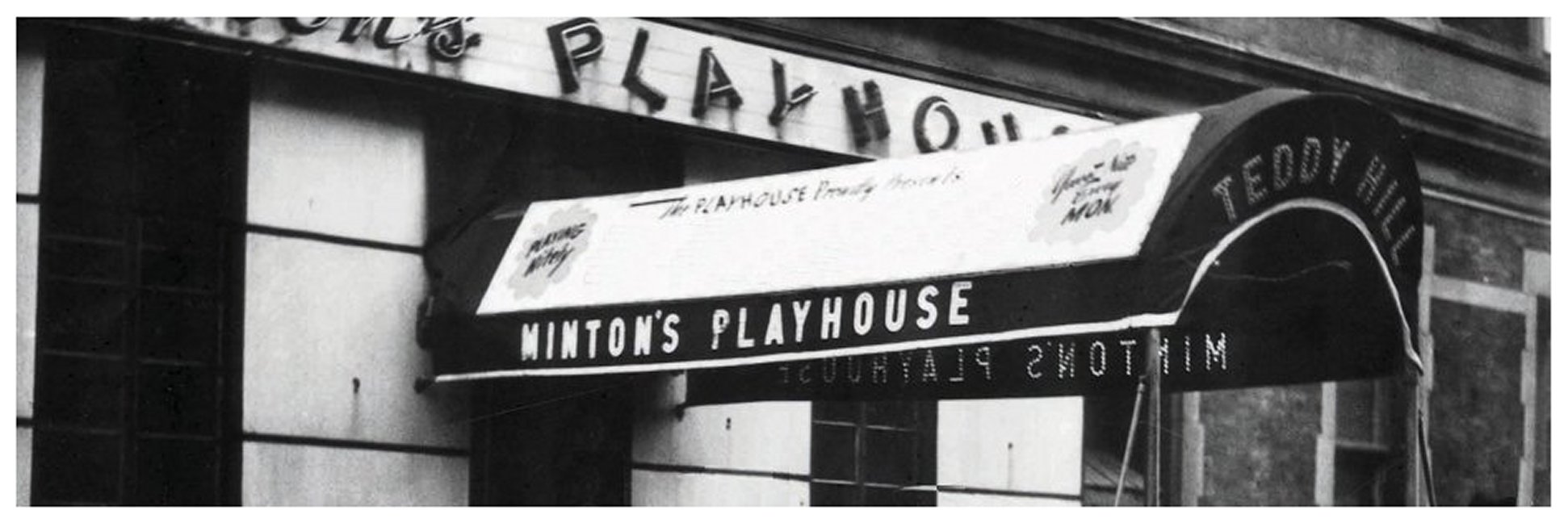
Christian was an essential fountainhead and bountiful contributor to the music that became known as bebop. Some of the participants in early after-hours affairs
at Minton’s Playhouse, an after-hours club located in the Hotel Cecil at 210 West 118th Street in Harlem where bebop was born, credit Christian with the name bebop,
citing his humming of phrases as the onomatopoetic origin of the term. Hammond described that time: “when the Goodman band was in New York, Charlie would go to jam
sessions at Minton’s Playhouse on the ground floor of the Hotel Cecil…There he was King of Harlem.”
Many of the great players in the area went to Minton’s and Monroe’s to interact to create the latest sounds in jazz. The owner Henry Minton opened Minton’s
Playhouse in October 1941 and put former bandleader Teddy Hill in charge. Hill made the club favorable to musicians encouraging them to jam with the house band
that included pianist Thelonious Monk, trumpeter Joe Guy, bassist Nick Fenton, and drummer Kenny Clarke who was in charge of musical direction. Hill provided
free supper for members of the bands playing at the finer nightclubs, especially at the nearby Savoy and Apollo in Harlem. Charles had taken New York by storm
and was highly respected due to his nonpareil talent. Teddy Hill brought in an amplifier specifically for Charles’ use. As far as the management at Minton’s
was concerned Charlie Christian owned the place.
Guitarist John Collins said, “When you went into Minton’s, there was a bar first and then you’d go further
back so it was two rooms…he was a nice individual, he dressed just nice…Charlie was the greatest”
 Lt Jerry Newman Lt Jerry Newman Charlie Christian’s bebop playing can be heard in a series of recordings made at Minton’s Playhouse by Jerry Newman, a student at Columbia University, on his
portable disc recorder in 1941, in which Christian was often accompanied by Joe Guy on trumpet, Kenny Kersey on piano, Nick Fenton on bass, and Kenny Clarke on drums.
On the recordings, Christian can be heard taking multiple choruses
on a single tune, playing long stretches of melodic ideas with ease.
Charlie Christian’s solos on “Topsy,” released as “Swing to Bop” on
almost all issues, are absolutely phenomenal – an unparalleled
achievement that’s beyond words. Christian’s
use of tension and release, a technique employed by Lester Young,
Count Basie and later bop musicians, is also present on Newman’s
recording of “Stompin’ at the Savoy.”
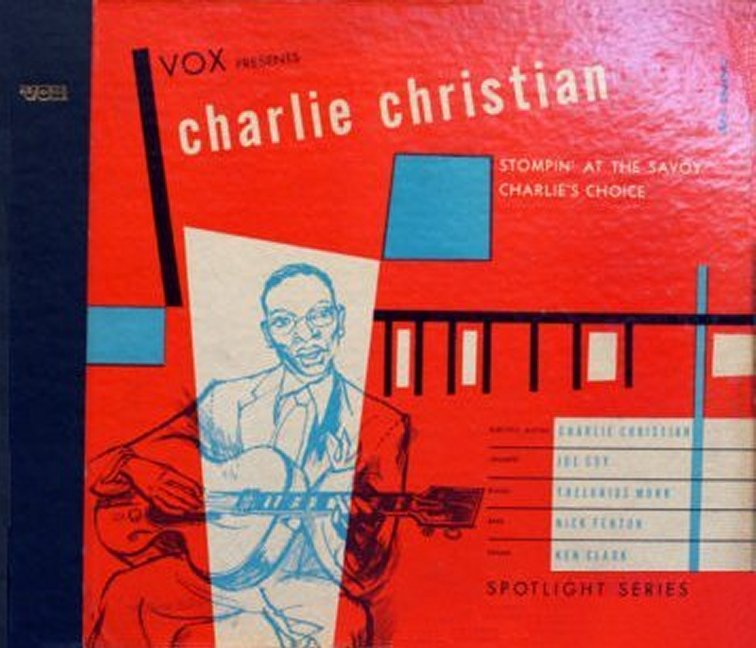 Vox
VSP 302 Vox
VSP 302
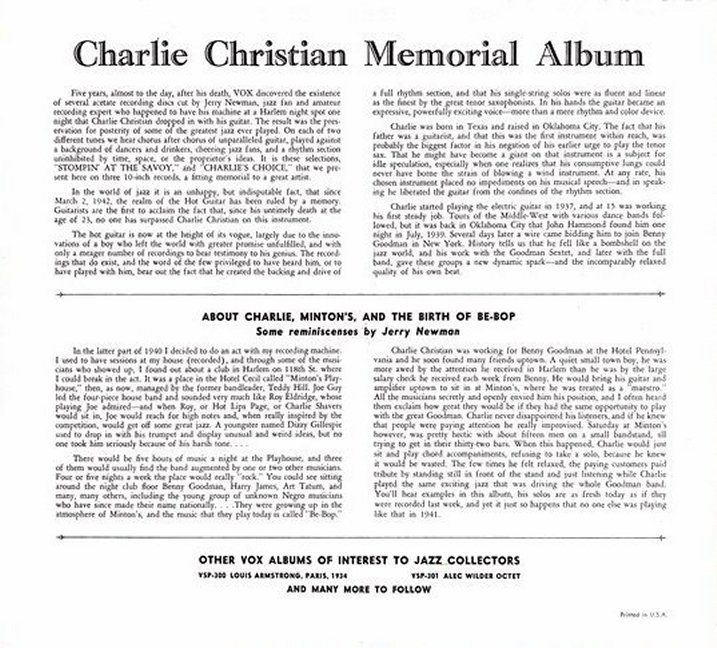 Newman’s most important achievement was capturing Charlie
Christian live at Minton’s in 1941. Christian, already a star from
his work with Benny Goodman, was pushing the electric guitar into
new territory, stretching the instrument into bebop. His pioneering
approach laid the foundation for generations of jazz guitarists.
Barney Kessel cited Christian as his “sole influence,” and Wes
Montgomery transcribed Christian's solos note-for-note early in his career.
Tragically, Christian’s health was failing due to tuberculosis. He
would pass away less than a year later, in March 1942. Newman's
lacquers are among the few documents we have of Christian breaking
free in a small-group setting. Without Newman, that pivotal chapter
in both jazz history and guitar innovation would have been lost
forever.
Adding even more weight to Newman’s work: in 1942, a nationwide
recording ban led by the American Federation of Musicians brought
commercial studio recording to a halt. The strike, which lasted into
1944, froze documentation just as bebop was beginning to flower.
With no labels capturing this moment, Newman’s homemade discs became
an accidental historical record. Further recordings were made in 1941, shortly before Christian’s worsening illness and hospitalization, at Clark Monroe’s Uptown House, another late-night
jazz haunt in Harlem, with Oran “Hot Lips” Page and tenor sax player Don Byas. Beboppers Thelonious Monk,
Dizzy Gillespie and Charlie Parker were regulars at the jam sessions but
were never recorded with Charles at the Harlem venues.
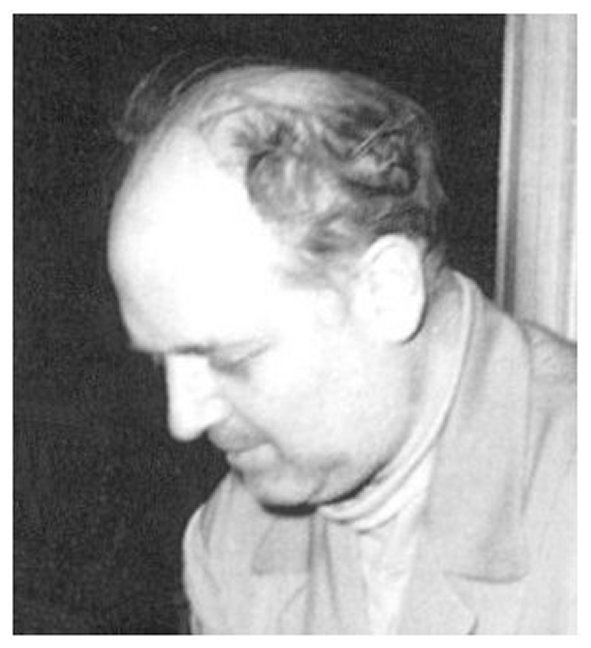
Jerry Newman, Esoteric Records founder and owner In his “Music in the Making” column in the November 1, 1952 issue of Melody
Maker, journalist Mike Nevard recounted Jerry Newman’s
recollections,
“I was in on the earliest days at Minton’s. It started in January 1941
at the Hotel Cecil on 118th Street. They turned the dining room into
a club and built in a stage for seven, and a bar. Henry Minton ran
the sessions. He was the first Negro delegate to the AF of M and
called the place Minton's Playhouse. I just went down there for
kicks. I was a kid with a recording machine. I used to do an
act...For that, Minton let me make any records I liked. Mostly, the
band down there was based on four guys – Thelonious Monk, Kenny
Clarke, Nick Fenton and Joe Guy. Nick’s
first violin with the Philadelphia Orchestra now, but he played bass
then. Joe was trying to do a Roy, but he couldn't keep his mind on
the trumpet. Monk and Kenny were the boys, though. They started it
with their odd beats. Kloop-mop they called it. Then rebop. Then
bebop.
“It got around. Soon a lot of guys were coming along nights.
Youngsters...Sometimes there were fourteen of them up there. Then
Christian came along. He was playing with Goodman then, but he was
still a shy country boy. The mob blew in on his solos; they saw my
record gear and they wanted to be in on it. Charlie wasn’t
happy. Just sat there playing rhythm. But occasionally he’d
let out. And I got some good stuff...I didn't know much about music
then. But I knew something was happening. Christian started learning
from Monk and Kenny. Then you could see them learning things from
him. And when Minton’s
shut down at four in the morning, we’d
take the recording machine out to Monroe’s
Uptown Housed and jam till seven or eight. Of course, we would have
to pay off the police so we could keep on drinking.”

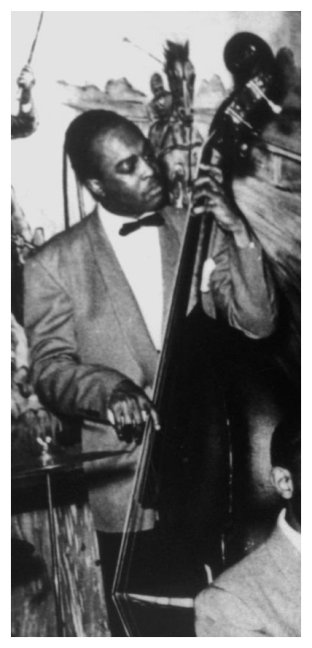

Kenny Kersey, piano Nick Fenton, bass Kenny Clarke, drums
Vernon Alley says, “every morning after he got through at Minton’s…Charlie would never eat so I would try to get him to eat because he’d been playing all night
and I was already in bed. He wouldn’t eat but he’d get out his guitar and start playing some more. When he came to my room he had that blonde fancy guitar but when
he was in San Francisco he had that dark one…”
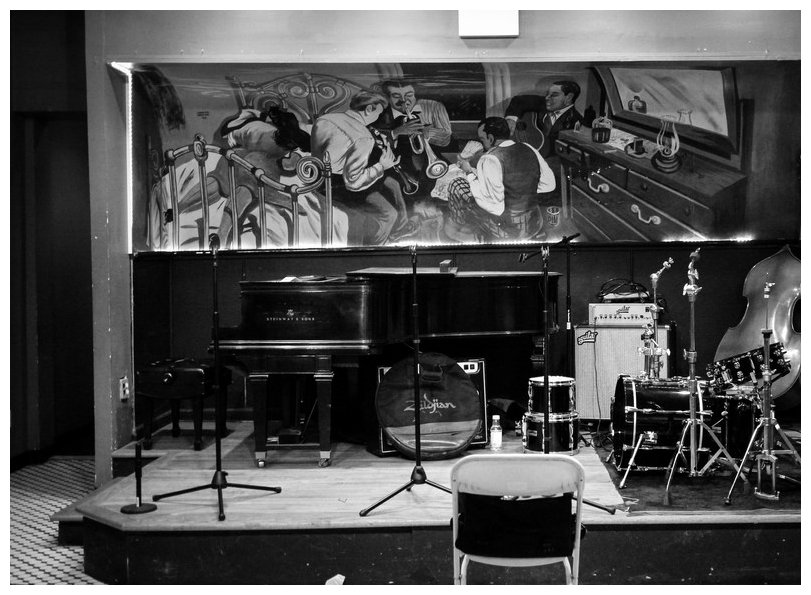
bandstand at Minton’s Kenny Clarke claimed that “Epistrophy” and “Rhythm-a-Ning,” which Christian played with Clarke and Thelonious Monk
at Minton’s jam sessions, were compositions by Christian. The “Rhythm-a-Ning” line is heard on “Down on Teddy’s Hill” and behind the introduction on “Guy’s Got to Go”
from the Newman recordings. It is also a line from Mary Lou Williams’s “Walkin’ and Swingin’.” Clarke further commented that Christian first showed him the chords to
“Epistrophy” on a ukulele.
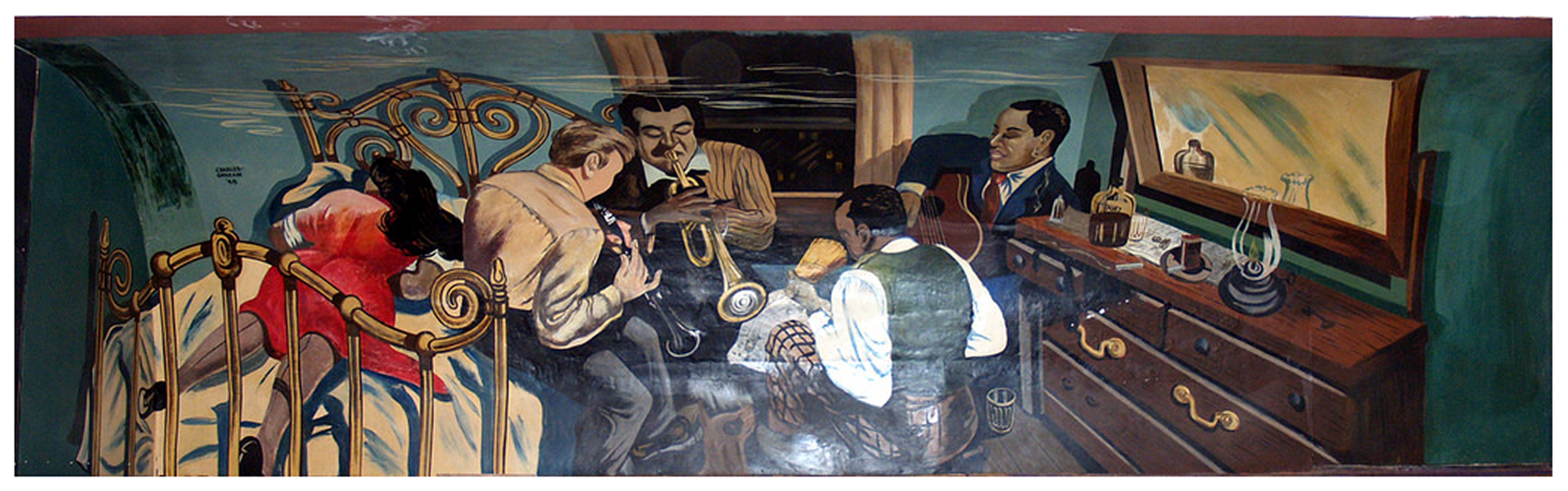
Mural behind bandstand This from Morgan and Horricks book
Modern Jazz: A survey of Developments Since 1939:
“…In New York…1940… guitarist Charlie Christian led the whole
progressive movement out into the open…a core of steadfast
supporters gathered about Christian… Christian at this stage was way
ahead of his contemporaries in many ways; in harmony, in the
reshaping of melody, in the elevation of new instruments and in the
basing of improvisation upon a more technical source. He actually
had the rhythm section into a unit of fresh conception and
approach…working in coordination with modern front line soloists…His
passing left musicians groping…to replace Christian’s steadily
mounting tower of creation…even for a giant like Charlie
Parker…shows the considerable spread and success germinated by
Christian’s concept, a concept which saw the promise in a series of
jam sessions…”


Minton’s Interior Today
A Mary Lou Williams interview, comprised of eleven installments in
Melody Maker from April to June, 1954, gives us this:
“That’s how we were then – one big family on West 118th Street. Minton’s was a room next door to the Cecil Hotel and it was run by
Teddy Hill, the onetime bandleader who did quite well in Europe, and who now managed for Minton. Henry Minton must have been a man
about fifty who at one time played saxophone and at another owned the famous Rhythm Club where Louie, Fats, James P, Earl Hines and
other big names filled the sessions. He had also been a Union official at Local 802. He believed in keeping the place up, and was
constantly redecorating. And the food was good. Lindsay Steele had the kitchen at one time. He cooked wonderful meals and was a
good mixer who could sing a while during intermission.
“When Monk first played at Minton’s there were few musicians who could run changes with him. Charlie Christian, Kenny Clarke, Idrees
Sulieman and a couple more were the only ones who could play along with Monk then. Charlie and I used to go to the basement of the
hotel where I lived and play and write all night long. I still have the music of a song he started but never completed.”
Allen Tinney, house pianist at Monroe’s Uptown House recalled, “He never hung out, he just came to the jam sessions. He was
a very nice person. Charlie was a serious guy and he was a dapper type dresser, he was just nice all the time. Charlie was just great.”
The Minton’s and Uptown House recordings have been packaged under
a number of different titles, such as After Hours, The Harlem Jazz Scene, and The Immortal Charlie Christian.
|
|
Hospitalization and Demise
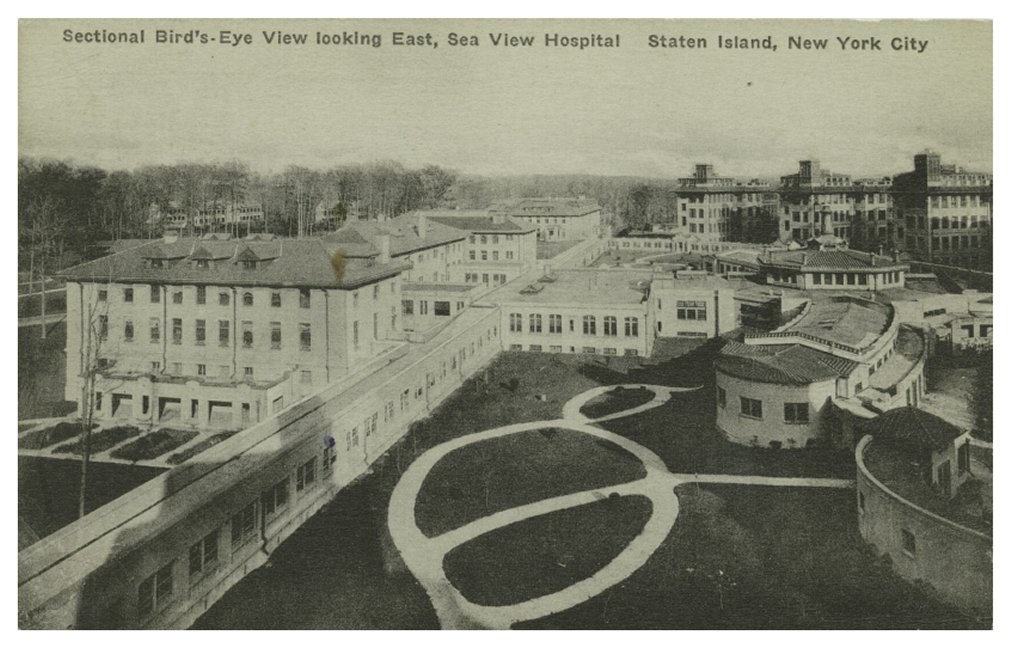
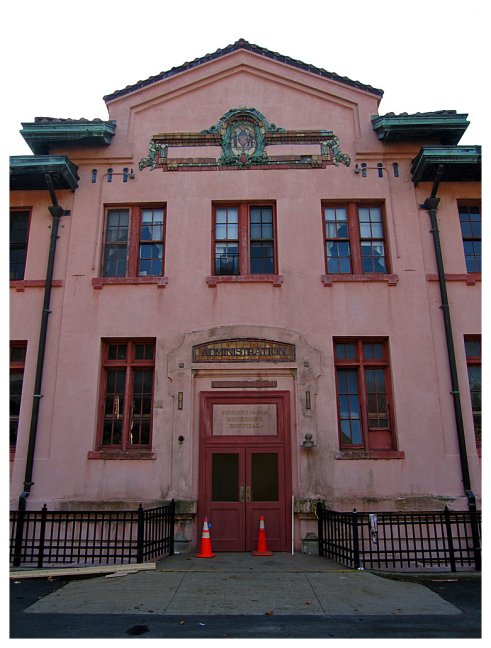
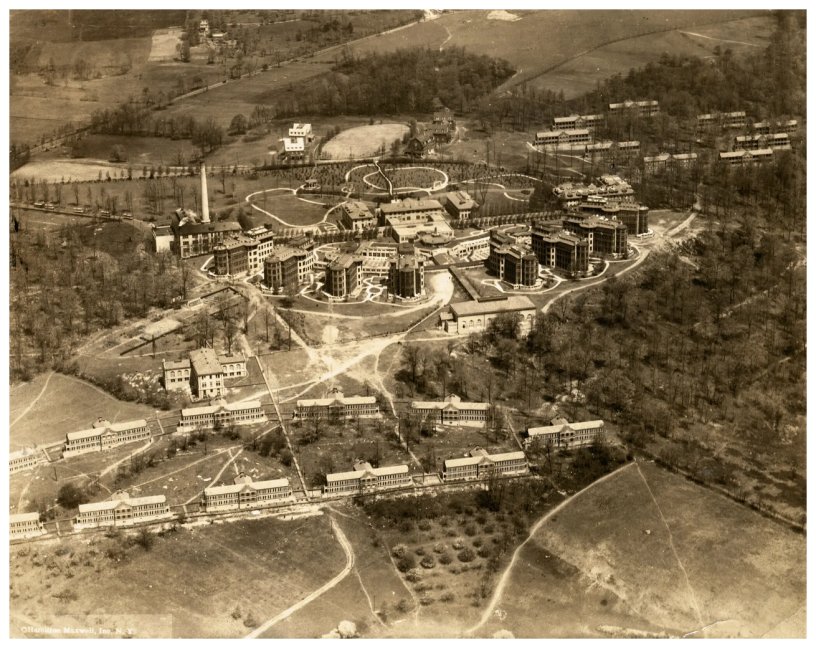
Seaview Hospital
In June 1941 Charles Christian was admitted to
Seaview Hospital, a tuberculosis sanatorium on Staten Island, a suburb of New
York City. He was reported to be making progress, and DownBeat
magazine reported in February 1942 that he and Cootie Williams were starting a band. But he eventually contracted
pneumonia. Friends and band members paid visits but since the Verrazano Bridge had yet to be constructed, the trip was a bit difficult and he had fewer visitors
than hoped for.
Dr Sam McKinney came from Harlem to check on him. Teddy Hill, Minton Playhouse manager, went to see him every Sunday. Charles had expected to
get a visit from Goodman but he never showed. It had been reported that Charles was “much improved” and “progressing rapidly toward complete recovery.”
There
had been a story circulating around that may have some truth to it, at least in part, that after a visit to the hospital that same month by a tap dancing, sporadic
drummer with marijuana and such, and maybe some young lady friends and the like,
Charles declined in health.
Charlie Christian died on March 2, 1942, at the age of 25.
Four funerals were held for Charles
Christian, the main one in Oklahoma City at the Calvary Baptist Church; simultaneous services were held in New York and Chicago.
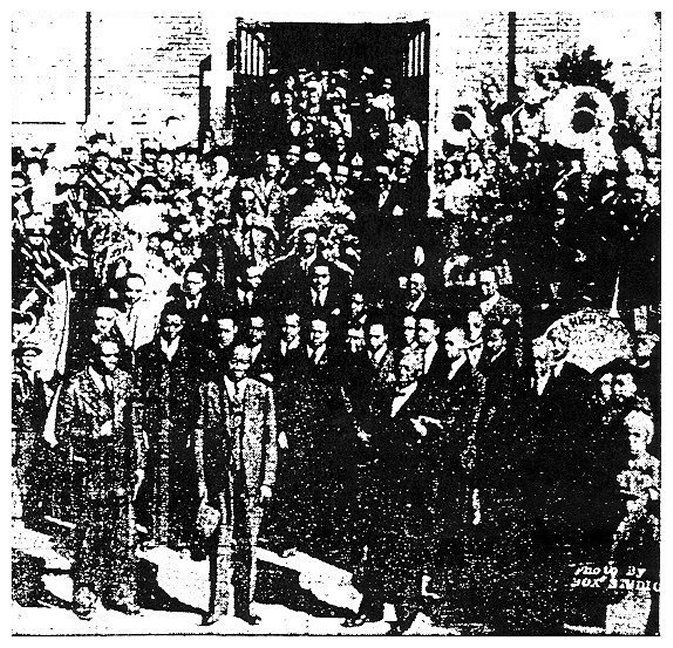
Calvary Baptist Church
March 9, 1942
The final services, which are
still remembered by many residents who knew Charles or his family, were held at his burial in Bonham, Texas. Charles’ body had been sent home from New York in
the cheapest coffin available. Back in Oklahoma, his family felt this to be below his dignity and provided a top-of-line casket in which he was buried.
Oklahoma City’s
The Black Dispatch, the newspaper operated by Roscoe Dunjee, described the funeral: “the flower-banked casket of Charles Henry Christian, thousands from
all walks of life, paid tribute to the memory of the 25-year old musician” The funeral was one of the largest, perhaps the largest black funeral in the history
of the state. A large spray of flowers was sent by the Goodman band an arrangement of flowers from local musicians in the shape of a guitar was near the casket.
“…perhaps the most elaborate funeral seen in Oklahoma City in a number of years.”
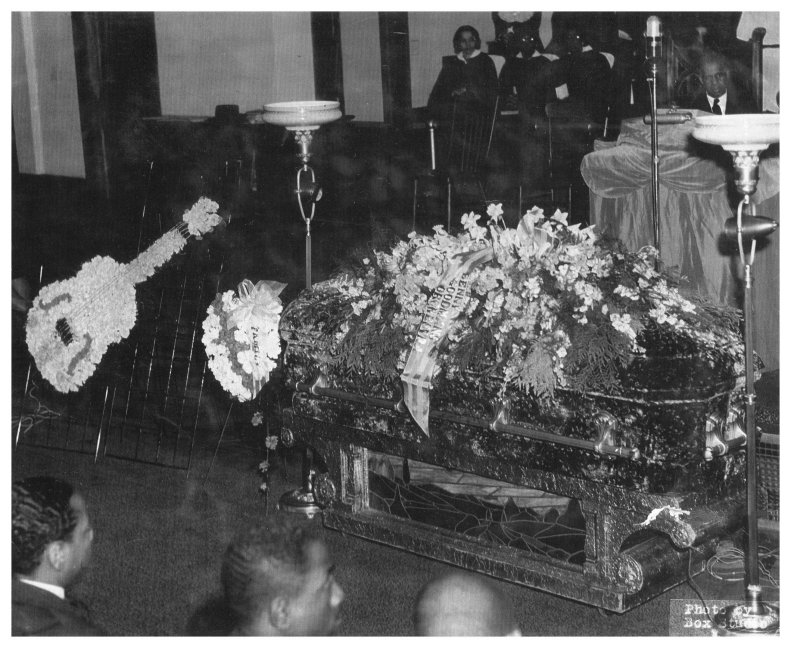 He was buried in an unmarked grave in Bonham in the
Black cemetery
south of town. A Texas State Historical Commission Marker and
headstone were placed in Gates Hill Cemetery in 1994 where the grave
was thought to be. The location of the historical marker and
headstone had been disputed, and in March 2013, Fannin County,
Texas, recognized that the marker was in the wrong spot and that
Christian is buried under a concrete slab, as claimed by his brother
Clarence.
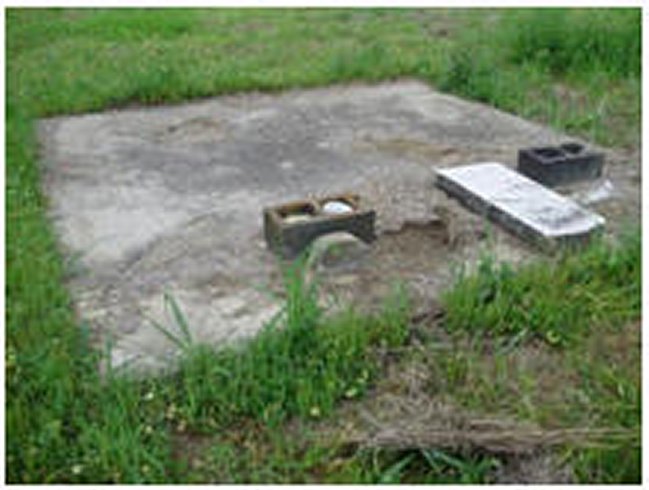
concrete slab
Gates Hill Cemetery
|
|
Style and Influences
Christian is widely regarded as one of the most influential pioneers of jazz guitar. His solos are frequently described as “horn-like,” and in that sense,
he was more influenced by horn players in his regional territory, such as Lester Young and Herschel Evans, than by early arch-top guitarists like Eddie Lang
and the jazz- and bluesman Lonnie Johnson, although they both had contributed to the expansion of the guitar’s role from the rhythm section to a solo
instrument. Christian stated he wanted his guitar to sound like a tenor saxophone. As Craig McKinney has so correctly said “the saxophone that Charles
was hearing was the one in his head, not a copy of Lester’s”
Although French gypsy jazz guitarist Django Reinhardt had little influence on him, Christian
was obviously familiar with some of his recordings. The guitarist Mary Osborne recalled hearing him play Django’s solo on “St. Louis Blues” note for note, but
then following it with his own ideas. Interestingly, Charles had a definite influence on Django – readily heard on Reinhardt’s later recordings, especially
when he had switched from acoustic to electric guitar almost a decade after Charles’ passing.
By 1939 there had already been electric guitar soloists – Leonard Ware, George Barnes; Eddie Durham
who had recorded with Count Basie; Floyd Smith, who recorded “Floyd’s Guitar Blues” with Andy Kirk and his Clouds of Joy in March 1939, using an amplified
lap steel guitar; and the Western Swing pioneer Eldon Shamblin, who was playing with Bob Wills and his Texas Playboys.
Not only did he revolutionize the world of jazz, Charlie Christian made a definitively
strong impact on Rhythm & Blues, especially in the Jump Blues genre. R&B/Jump guitarists such as Saunders King, Tiny Webb (aka Herman Mitchell), Gene Phillips
(& The Rhythm Aces), Bernardo Dennis (with Willie Dixon’s Big Three Trio), Carl Hogan (with Louis Jordan), Ted Summitt (with Sonny Boy Williamson, et al), Steve Gibson (Red Caps) were significantly
influenced by Charles. And in Jazz/Blues, there’s Slim Gaillard (of Slim & Slam), Teddy Walters (with Cozy Cole All Stars), Tiny Grimes (& His Rocking Highlanders),
Oscar Moore (of the Nat Cole Trio). They all praised Christian and acknowledged their obvious debt to him. Christian phrasing and phrases are repeatedly noticeable
in all of these guitarists’ solos.
Christian paved the way for the modern electric guitar sound that was followed by others, including T-Bone Walker,
B.B. King, Cliff Gallup (rockabilly), Scotty Moore
(Blue Moon Boys, Elvis Presley's backing band), Franny Beecher (with Bill Haley & the Comets), Chuck Berry, Carlos Santana and Jimi Hendrix.
Consequently, Christian was inducted into the Rock and Roll Hall of Fame in 1990.
Christian’s exposure was so great in the brief period he played with
Goodman that he influenced not only guitarists but other musicians as well. The influence he had on Dizzy Gillespie, Charlie Parker, Thelonious Monk and
Don Byas can be heard on their early bop recordings “Blue ’n’ Boogie” and “Salt Peanuts.” Other musicians, such as the trumpeter Miles Davis, cited Christian
as an early influence. Indeed, Christian’s “new” sound influenced jazz as a whole. He reigned supreme in the jazz guitar polls many years after his death.
Much of the incredible jazz guitarist Wes Montgomery’s early improvisation came
from imitating Charlie Christian’s guitar solos note-for- note.
Early on, tenor sax great John Coltrane showed significant influence by
Charles, particularly on blues.
During his time and way beyond Charlie Christian was a musical
prodigy far and away more sophisticated and advanced than any other
musician in any genre – much like Mozart in his day.Whitney Balliett offers this excellent exposition in
his record review in the May 13, 1972 issue of The New Yorker
“Christian was not the first great jazz guitarist, although it now
appears that he will be the last. He was preceded, in the
mid-thirties, by the masterly Belgian eccentric Django Reinhardt,
whose graceful melodic calligraphy remains permanently fresh.
Christian knew Reinhardt’s work, and, the legend goes, could play
some of his solos note for note, but that is as far as the
admiration went. He applauded vigorously, then went his own way.
(One wonders what Reinhardt thought of Christian’s recordings, if,
indeed, he knew them at all. He never heard Christian in the flesh,
for he visited this country only once, in 1947, and Christian never
got to Europe. What a marvel they would have been in a duet
—Washington and Lincoln breaking bread!) Reinhardt was mainly an
acoustical guitarist, and Christian was the father of the electric
guitar. He never indulged himself by playing too loud or by hiding
under the shimmering surface of his instrument. Instead, he used it
as it was meant to be used— as an electronic catapult for what is
basically a soft and secret instrument. At the same time, he was the
first guitarist to transcend the guitar; that is to say that, in the
manner of all great jazz musicians, what he played—the curves and
blocks and lines of melody—became more important than the instrument
itself. (Lesser musicians never quite reach this threshold but
remain at the mercy of their instruments.) His style was a model of
clarity and design and order. It had the wastelessness and purpose
of geometry, the liquidity and logic of Albers. But the laconic
exterior was frequently ruffled, for Christian freely transmitted
the emotions that drove him—those unfathomable, nameless emotions
that compel all first-rate music—and he did it without ever
disturbing the master plan each solo seemed to follow. He was an
astonishing technician, and at the age of twenty he had already
learned a seminal secret about jazz improvisation that few players
twice his age know— the value of silence. He rounded his phrases,
which ran anywhere from one to ten or more bars, with little rests—
some of them a beat in length, some a whole measure. They had a
pleasant shock effect, and they allowed the listener to catch up
with what had gone before and to ready himself for what was to come.
(One of the strangest things about Christian’s legion of imitators
is that almost to a man they have completely ignored this brilliant
aspect of his style. Indeed, they play thousands and thousands of
notes non-stop, as if sheer musical poundage would raise them to
Christian’s stature.)
“Christian loved the blues, as all Southwestern
musicians do, and several of his choruses went like this: He’d start
with a ringing, descending two-note phrase, repeat it quickly two or
three times, and pause. He then reversed the notes, added several
others, slid into a lingering, behind-the-beat legato passage, a
drifting-with-the-current passage, and paused again, briefly,
suddenly climbed into fast, on-the-beat eighth notes that surged up
and down the scale, and ended in a rocking, offbeat chord. A simple,
ingenious riff popped out at the beginning of the next chorus, and
he repeated it several times, achieving a concentrated, singsong
effect. Then he abruptly broke out of the riff, passed through a
silent clearing, fashioned a crazy descending phrase full of odd
notes, and kept compounding the phrase past the end of the second
chorus and halfway into the third. He then went limp and legato
again, and, remembering the riff, repeated it once, lightly, and
made way for the next soloist, who almost invariably began with a
paraphrase of Christian’s last measure. Christian’s rare recordings
of slow ballads were tropical delights. He pushed the melody
straight before him, allowing it to swell sumptuously here and sink
easily there, then took the melody, and, in a passage resting on
long-held glistening notes, turned it gently inside out before
returning to direct melodic ruminations. His ballads became fat,
sensuous slow-motion dreams that filled the listener’s mind.
Christian’s imagination, no matter the tempo or the materials,
seemed to have no limit, and it is a pity that Goodman did step on
his heels most of the time.
“But how fine that we do have a handful of
recordings—made by amateurs in night clubs—in which Christian
stretches out and sounds as if he could play a hundred straight
choruses without repeating a phrase. Three of these on-the-spot
treats are now available, for the first time, in a new Columbia
release, Solo Flight: The Genius of Charlie Christian (G 30779),
and they are marvelous. They are extended versions of ‘I Got Rhythm,’ ‘Star Dust,’ and
‘Tea for Two’—all of them recorded in a club in Minneapolis in September of 1939. The first
number, a fast one, has four Christian choruses (spliced from two
different versions); the second has two superb slow, singing
choruses; the last has three perfect statements. Also on hand are
Jerry Jerome (a middling tenor saxophonist who was with Goodman at
the time), a pianist named Frankie Hines, and the bassist Oscar
Pettiford. Everything of Christian is here—the rests, the little
riffs, the funny interpolations, the long, charging, on-the-beat
phrases, the way-out notes and chords that were to be part of the
cornerstone of the bebop movement, and, above all, the transcendent
authority. The rest of the LP consists mostly of sides made with
Benny Goodman—two of them with the big band and the rest with small
groups. A third of the latter are alternate takes that have never
been released before (‘I
Found a New Baby,’
‘Royal
Garden Blues,’
‘Wholly Cats,’ and
‘All Star Strut’ among them), and in
‘Breakfast
Feud’ four Christian choruses, three of them lifted from unissued
takes, have been spliced. Also included are two long studio warm-up
numbers, in which Christian, along with Georgie Auld, Cootie
Williams, Johnny Guarnieri, Artie Bernstein, and Dave Tough, rambles
around comfortably in the blues. (One of them,
‘Waitin’ for Benny,’
has a wonderful bonus—a relaxed and brilliant open-horn Williams
solo.) Not included, though, are the ten or so other
Goodman-Christian efforts, and it’s too bad; we would finally have
had their complete oeuvre at hand. Most of the small-band sides
among the present recordings have long been considered classics, but
they would not be so without Christian. Listen to the pre-Christian
Goodman small-band records and to the ones Goodman made after
Christian—who had barely said hello to the world—was gone.”
|
|
Musical Legacy
Charlie Christian has inspired countless players during his lifetime and in the years following his death, and the guitarist has been given
numerous accolades. Much of the inspiration has come from Charles’ perfect rhythmic swing that had tremendous drive and an easy fluidity of phrasing in every
thing that he played – solos, riffing, rhythm whether chords or single-string accompaniment. Most of that rhythm was providentially innate; the drive from
that same rhythmic zest, enthusiasm and love of the music. It was always elegantly presented – wonderfully uplifting and inspiring to his audience. The
creativity in Charles’ playing could be discerned by his fellow musicians and those with any aptitude for music. All were elevated by his genius.
His composition “Solo Flight,” a hit featuring Christian with the full band, arranged by Jimmy Mundy, made the top of Billboard’s
Harlem Hit Parade in 1943.
In 1966, 24 years after his death, Christian was inducted into the Down Beat Jazz Hall of Fame.
In the liner notes to the album Solo Flight: The Genius of Charlie Christian (Columbia, 1972), Gene Lees wrote that “Many critics and musicians consider
that Christian was one of the founding fathers of bebop…”
In a 1985 interview with
Frets magazine, Jerry Garcia named Charlie Christian and Django Reinhardt as the two guitarists who most inspired his awe and emulation.
The first annual
Charlie Christian Jazz Festival was held in the spring of 1985. It continues to this day.
In 1989 the
Oklahoma Jazz Hall of Fame created its first seven inductions, which included Christian.
Christian’s influence reached beyond jazz and swing. In 1990,
Christian was inducted into the Rock and Roll Hall of Fame in the “Early Influence” category.
The official CC website, Solo Flight: The Charlie Christian Legacy went online in the autumn of 1998 causing a flurry of publications of numerous
Charlie Christian books and recordings, and a significant amount of chatter and interest in online message boards and forums for a decade or two.
In 2006, Oklahoma City, where Christian was raised, renamed a street in its Bricktown entertainment district after the guitarist:
Charlie Christian Avenue.
In 2012,
Bonham, Texas, where Charlie Christian was born, renamed South First Street after him:
Charlie Christian Street.
The Fannin County Museum in Bonham maintains a permanent exhibit
on the life and music of Charlie Christian.
|
|
Quotes
“The world doesn’t know how fantastic
he was,” notes a quote by jazz pianist Mary Lou Williams.
In a 1966
blindfold test, pianist Thelonious Monk was asked by Leonard Feather
what he thought of the playing of a well-known contemporary jazz
guitarist. Monk answered “Charlie Christian spoiled me for everyone
else.”
Guitarist Wes Montgomery when
asked how he got interested in guitar: “Charlie Christian, like all other
guitar players. That cat tore everybody’s heads
up. I never saw him in my life, but he said so much on records. I
don’t care what instrument a cat played, if he didn’t understand and
feel the things that Charlie Christian was doing, he was a pretty
poor musician.”
Benny Goodman on being asked on the Johnny Carson
Show what one player he would like to go back in time and play with.
It was Charlie.
Trumpeter Miles Davis
cited, in more than one interview, that Charlie Christian was a
major early influence on his playing. In his self-titled
autobiography Miles admits he modeled himself after Christian.
Jazz guitarist Jim Hall: “He was just so incredible. And
there are a bunch of jam session [recordings] too. I think Thelonious Monk was involved. But
there was something about how decisive his playing was, and clear, crystal clear, and great. And
it swung like—almost etched in stone, or whatever you do. I still can’t get over that when I hear
his records; it’s just so clear. No nonsense at all…”
Guitarist John Scofield: “Miles Davis told me
that he thought Charlie Christian was the original instigator of the
bebop movement, Bird and Diz's main influence. When you listen to
his playing today, it's still inspiring, fresh, harmonically and
rhythmically advanced. I loved the fact that the modern jazz
movement seems to have been started by an electric guitarist!”
Guitarist Tal Farlow: “I didn’t know whether it was the sound or the
music that he was playing that fascinated me…I learned all of
Charles solos…I got all of his records as soon as they came out.”
As
Tiny Grimes, among the first guitarists to fall under Charlie’s
spell, put it: “After I heard Charlie Christian, I had no use for
anyone else.”
Saxophonist Buddy Collette: “I tried to get the sound
of Charlie Christian, tried to get his sound on the saxophone…I was
influenced by Lester Young and Charlie Christian.
Guitarist Barney
Kessel: “the music Charlie made changed the guitar world. Anyone who
studies him can see where all of the guitar players that came
afterwards evolved from his fountainhead.”
Guitarist John Scofield stated that Miles Davis told him Gillespie
and Parker “got that stuff from Charlie Christian.”
Guitarist Jimmy
Gourley: “The Minton’s recordings came out and they really knocked
me out! Charlie was really tearing up the guitar, making it a
marvelous linear voice.”
As one of his disciples, fellow
Texan Herb Ellis, put it: “If Charlie were alive today, we’d still
be taking lessons from him.”
Basie’s rhythm guitarist extraordinaire
Freddie Green: “Well, he was the greatest I ever heard…Everything he
played was so pleasing, there was no effort, though a great deal of
it was very dexterous – those chords and things weren't easy.”
Here’s a quote from guitarist Mary Osborne, talking about when she first saw him in 1938.
“His drive was just great. The swing and beat was so beautiful, tremendous, and this made the most
impression on me…To play some of those things he had something going with his left hand, a fingering
that must have made all that possible, because he moved so fast. I still haven’t heard anybody play like him.”
Mary
Lou Williams, arranger and pianist for Andy Kirk and His Clouds of
Joy, heard Christian play and pronounced him the “greatest electric
guitar player” she’d ever heard and went on to recommend Charles to
producer John Hammond.
Bassist Oscar Pettiford: “I never heard
anybody like that, who could play with do much love – that’s what it
was, pure love of jazz, and great happiness just to be part of thing
called music.”
Jazz guitarist Steve Khan says, “If you haven’t taken
the time to go back, and to listen to Charlie Christian, you will
truly be amazed at how much of Wes Montgomery, Kenny Burrell, Grant
Green and others you will hear in his very futuristic playing. He
was so far ahead of his time. A great, great pity that he passed
away at such a young age.”
And here’s saxophonist Jerry Jerome: “I just loved playing with him ’cause
he was a rhythm section by himself, and even when he played with rather non-professional
type players he made them sound professional because they had to go with his very strong four-four beat he had.”
Guitarist/trombonist/arranger Eddie
Durham remarked “I've never saw anyone learn so fast, nor rise to
the top so quickly.”
Jeff McCord in a CD review for the
American-Statesman: “Everywhere, there are moments – a melodic
twist, a stray note placed in exactly the right place – that
dazzle…Christian is always off in a new direction…In eighteen
months, Charlie Christian showed us the way ahead. If the proof
wasn't right here, you never would have believed it was possible.”
Jazz critic Gary Giddins has said, Christian was “the guy who really
put the instrument on the map.”
Allan Kozinn and coauthors in The
Guitar, “Christian… has been jazz guitar’s only authentic figure of
genius, responsible for synthesizing the best elements of the
instrument’s previous history into a seamless, totally original
approach of such great melodic-harmonic resourcefulness that it has
served as the basis for literally all subsequent developments in the
instrument’s usage in jazz.”
|
|
Instruments and approximate dates of possession
(this instrument section was taken
virtually verbatim from the late Peter Broadbent’s
book on Charles)
∙ Epiphone Deluxe guitar (an acoustic arch-top guitar), 1934 – 1939
∙ Gibson ES-150 guitar (sunburst finish, with dot inlays on the fingerboard), and EH-150 amplifier, 1939 – April 1940
∙ Gibson ES-250 guitar (custom built by Gibson with a natural finish, a Super 400 tailpiece, and bowtie inlays on the fingerboard),
April 1940 – February 1941.
A Gibson Company instrument record sheet shows that an ES-250 (serial number 96060) was shipped, along with an EH-150 amplifier (serial number 12706),
to Chas Christian on April 19, 1940. This instrument was re-discovered in 2002 and is currently, scrupulously displayed at museums and guitar shows
across the country.
∙ Gibson ES-250 guitar (custom built by Gibson with a natural finish, an L-7 style neck, and custom inlays on the fingerboard,
February 1941 – March 1942
∙ Gibson L-5 guitar (custom built by Gibson with a “Charlie Christian pickup” instead of a P-90).
This guitar was delivered to Charles just prior to his death in March 1942. It was later owned by Tony Mottola.
Early amplifier Christian used was a 15-watt EH-150 model with 10-inch speaker.
Later amplifier Christian used was an 18-watt EH-185 model with 12-inch speaker.
ES stands for Electric Spanish
EH stands for Electric Hawaiian
L stands for Lloyd Loar, a Gibson master luthier
The bar-style pickups used on the ES-150 and ES-250 Gibson
guitars became known as the “Charlie Christian pickup.”
|
|
Interviews
|
Benny Goodman: The Complete 1982
Interview About Charlie Christian
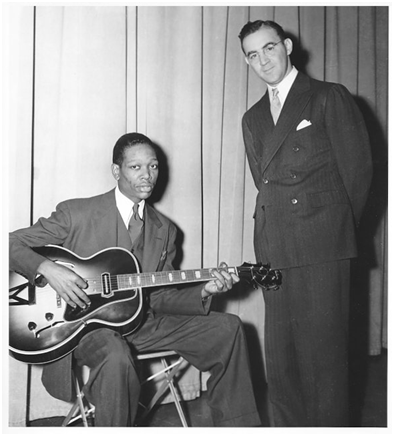
Charlie Christian expanded the
boundaries of jazz and left us an unsurpassed
collection of early electric guitar recordings. A
brilliant soloist, Charlie departed Oklahoma City in
August 1939 to try out for Benny Goodman’s band.
Playing the electric guitar, then a fairly new
instrument, Christian quickly proved that he had the
tone, imagination, and finesse to create long,
flowing melodic lines that were equal to those of
Goodman’s horn players, who were among the best in
the country. Within weeks, the 23-year-old guitarist
had recorded “Flying Home,” “Stardust,” “Rose Room,”
“Seven Come Eleven,” and other classics with the
Benny Goodman Sextet. He performed at that year’s
Spirituals to Swing Concert at Carnegie Hall as part
of the Benny Goodman Sextet and alongside Lester
Young and Buck Clayton in the Kansas City Six.
Christian’s impact was immediate: By year’s end, he
had won the first of three consecutive Best
Guitarist awards from Downbeat magazine. Players
across the country sought out his recordings and
broadcasts with the Sextet and longed for a guitar
like his Gibson ES-150. As Barney Kessel, one of
Christian’s earliest and most successful disciples,
wrote, “The music Charlie made changed the world.
There have been very few people on any instrument
since Charlie that have had his sense of time, his
spacing of notes. He was years ahead of most of his
contemporaries in terms of the lines he was playing,
which involved certain chord changes that were
non-existent until then. Charlie’s tone was the
concept for what is being used today in jazz.”
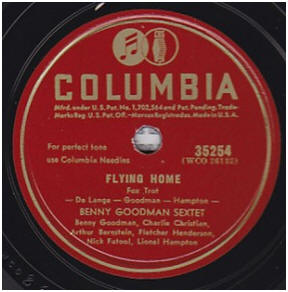
During 1940 and early ’41,
Christian continued to record influential songs such
as “Till Tom Special,” “Gone with ‘What’ Wind,”
“Wholly Cats,” “Air Mail Special,” “Breakfast Feud,”
and his specialty number with the full Benny Goodman
Orchestra, the magnificent “Solo Flight.” Another
masterwork was his improvised “Blues in B,” with its
five-chorus solo. After hours, Charlie often headed
to Harlem to jam at Minton’s Playhouse, where
Thelonious Monk and Kenny
Clarke served as the house band and Dizzy Gillespie,
Charlie Parker, Lester Young, Ben Webster, and
Coleman Hawkins were regulars. It was here,
witnesses insist, that the foundations of bebop were
created. In May 1941, a young jazz enthusiast
recorded Christian at Minton’s playing “Swing to
Bop,” “Stompin’ at the Savoy,” and other
compositions. Two months later, the hard-partying
guitarist, who’d been diagnosed in 1940 with
tuberculosis, was admitted to Seaview Sanitarium on
Staten Island, where he passed away on March 2,
1942.
As a special tribute, I wrote the March 1982 Guitar
Player magazine cover story on Charlie Christian.
Barney Kessel, a columnist for the magazine, wrote a
sidebar about Charlie’s style. The article didn’t
seem complete, though, without input from those who
actually knew Christian. On a whim, I called an
operator in Manhattan on November 20, 1981, and
asked if she had any listings for Benjamin Goodman.
She told me she had five “B. Goodman” listings, and
I asked for those. On my second attempt, an elderly
gentleman answered the phone.
***
Jas
Obrecht: I’m looking for Mr. Goodman, the bandleader.
Benny Goodman: This is Mr. Goodman, yes.
I’m writing an article on the 40th anniversary of
Charlie Christian’s death . . .
Has it been that long, has it?
It will be 40 years in March.
Really?
Could I ask you a few questions about him?
Why not? Go ahead.
When you first heard of Charlie Christian, did you
think an electric guitar could fit into your music?
[Long pause.] Well, I always played with guitar
players before that – is that what you mean? With
Dick McDonough and Carl Kress, so I don’t think that
part of it was terribly unusual, except he was such
an unusual player! And of course, it was electric,
yes.
What distinguished Charlie’s style?
Well, he was unique! A brilliant musician.
Inventive. Well, there’s nothing you could say about
him more than that, you know. He was way ahead of
his time, and a joy to listen to.
What were your first impressions when you met him?
Well, he wasn’t the most imposing figure in the
world – is that what you mean? He was retired and
reserved and thin. Of course, he might have been –
well, I don’t know. Well, anyway, he was rather shy.
He enjoyed a good laugh. But by gosh, when he sat
down and played the guitar, he was something! Did
you ever have a chance to talk to Mary Lou Williams
about him?
No, I didn’t.
Oh, you didn’t. She knew him a long time ago, didn’t
she? Do you remember her knowing him?
Yes, she’s the one who told John Hammond to go see
him.
Oh, I see. I see.
There’s a story that you were playing at a club, and
John Hammond put Charlie on the bandstand without
your knowledge.
I don’t remember that [laughs]. In any event, it’s a
nice story. I think that was in Beverly Hills,
wasn’t it?
Right.
Do you know the name of the club?
No.
I think it was Beverly Hills.
Hammond reported that you did a jam on “Rose Room”
that went on for about 40 minutes.
I don’t remember that. I don’t remember how long it
went.
Were you pretty sure you wanted Charlie in the band
after that first time you played with him?
Oh, yeah. No doubt about that.
Did he fit in with the other guys right away?
You mean the rhythm section? Yes, of course.
Everybody was delighted with him.
Was he easy to work with?
Oh, yes.
Would you say he was a schooled musician?
Well, I really don’t know about that, but it didn’t
make any difference at all, did it? You mean did he
read music? I don’t really remember that at all.
Did his playing change much while he was in your
band?
I don’t think so. It didn’t have to, did it?
[Laughs.] And after all, he was only with me a short
time. He got ill pretty soon after that. I forget –
what date was it he joined me?
I think he joined you in late ’39, and he died in
’42.
Yeah, so it wasn’t very long, you know. He played
with me at the Paramount Theater and made quite a
few records with me. I don’t think there was really
much time for anything to change. Of course, he made
all of the other records that were recorded up at
Minton’s, didn’t he? He was an amazing player to
listen to.
Did he have immediate impact on other guitar
players?
Well, I think you’d have to ask guitar players about
that! [Laughs.]
What about the guys who came into your band after
Charlie left? Did they adopt his style?
[Long pause.] Gosh, I don’t know. I don’t know if
anybody ever sounded like him, really.
How popular was Charlie in his lifetime?
Well, he was very popular. With the public, you
mean? Yes. He didn’t have enough time to really
establish himself, so to speak, but he was an
immediate success on concerts and records.
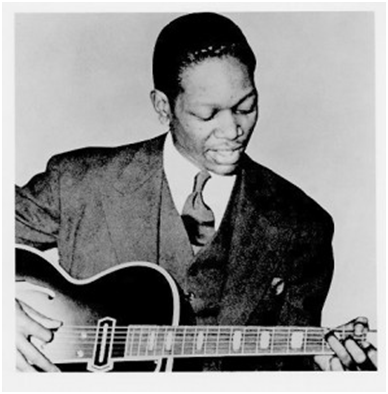
Some books now claim that Charlie
was instrumental in pioneering bebop.
Well, that’s true, isn’t it? Yeah. But to me, he
sounded quite different than that. He wasn’t as
hectic as bebop, as far as I’m concerned. But I can
see the influence that I can imagine that some
people would say he had over bop. His inventions,
his harmonic structure – quite miraculous. There was
a phrase in – what was it? [Sings several measures
of Christian’s “Air Mail Special” solo.] Remember
the release? Yeah. [Sings some “Air Mail Special”
riffs.] Those kinds of phrases – extraordinary!
What were Charlie’s strongest points musically?
Oh, gosh. He had everything!
Did he have any weak points?
No. No.
Forty years later, Mr. Goodman, what do you think
Charlie Christian contributed to jazz?
A great deal. A lot of people influenced by him,
including me.
Is there anything else you’d like to say about him?
Well, I think he was great loss, and I’m delighted
that you’re remembering him in this article. Thank
you very much – I’m delighted to talk to you. And
good luck!
May 14, 2011 Jas
Obrecht
|
Internet posts:
|
Guest post by Mike Okazaki:
Stompin’
at Minton’s
Christian played rhythm guitar as well (you can hear this before the “Stompin’”
solo begins), and he was a more than acceptable bass player. One of the best sources of detailed technical information about Christian’s playing is Barney Kessel, who spent a few days in Oklahoma City with him in the Fall of 1940, and and who knew enough about guitar and the magnitude of Christian’s talent to make good observations. (Kessel was also from Oklahoma, born 7 years after Christian, and at this point was 17 years old, already gigging.) Kessel said:
Swinging – yeah. See, but even when I say that, there’s a lot of people that still don’t know what I’m talking about, because they would think that it means swinging your body or kind of grooving and boogying all out, and all that. It’s got to do with the pulse in your playing. It’s got to do with the fact that you play in such a rhythmic way – and I’m not talking about whether you rush or drag. I’m talking about if you play a stream of eighth notes, that you play it in such a way that your time is so flawless that you wouldn’t need a bass or drum for someone to sense what the tempo is. It’s got such clarity and it’s so articulated that without any rhythm instrument there, you definitely hear what the tempo is. Whereas with a lot of people, they don’t play evenly. They don’t play that way, so without a bass or drummer, the tempo is not clearly stated.
(Interview with Jas Obrecht)
One interesting thing about the guitar is that there are many duplicated notes. This allows a player to develop a personal approach to the formations and fingerings that they use to get at any particular series of pitches. Christian’s solos are full of very strong physical formations that lay beautifully on the instrument. I believe that a great amount of the rhythmic force and clarity that Christian communicates is made possible by the positions of the left hand, that he discovered a vocabulary of fingerings that speak naturally with simple picking strokes.
There is no known video footage of Charlie Christian, but the consensus among players is that he used a majority of downstrokes with the right hand, and mostly three fingers with the left hand. A well-known quote, again from Kessel, describes some important details:
He rested his 2nd, 3rd and 4th fingers on the pick-guard. He anchored them there so tensely that it was like there almost wasn’t a break in the joint. He almost never used the 4th finger of his left hand.”
(Kessel in Guitar Player, Oct ’70)
This description of the left hand makes sense, given the logical fingerings that can be used to play the solos, and is supported by the few pictures that we have of Christian in the act of playing. In certain circles of guitar playing, tucking away the fourth finger and putting the thumb over the top of the neck is considered improper technique. I would side with the contrary view, that this is an absolutely natural way to approach the guitar when the goal is strong articulation, groove, and rhythm. Using primarily three fingers does not at all limit speed or harmonic options — look at all the stuff drummers can play with two sticks! And the third finger easily spans four frets when the hand is angled towards the guitar’s body. This approach is clear in the video footage that we do have of Wes Montgomery and George Benson, who modeled their styles after Christian. I once had the pleasure of sitting with George Benson in his house and listening to this very solo on the record player, while he pointed out his favorite lines.
—
It’s hard to talk about Charlie Christian without considering the extraordinary social context of his career. By the time “Stompin’ at the Savoy” was recorded, Christian was a star, having been in the spotlight with Benny Goodman for nearly two years. At the same time, he was burning the other end of the candle as a member of the house band at Minton’s. There are some anecdotes about these worlds colliding – this one comes from Kenny Clarke:
When Benny Goodman was rehearsing at the Pennsylvania Hotel he would come occasionally with Charlie to sit in at the club. Clarke told me that the band would then play swing music to “accommodate” Goodman and that he remembered the
clarinetist sitting in with Lester Young and accompanied by Thelonious Monk on piano and Charlie playing double bass.
(Broadbent, p. 116)
Whether this is apocryphal or not, it’s great to imagine the scenario. At the point of “Stompin’ at the Savoy,” Christian was 24, and had less than a year before tuberculosis took his life. Lester Young biographer Douglas Henry Daniels writes:
The deaths of his [Lester Young’s] former sideman Clyde Hart and of Jimmy Blanton and Charlie Christian, also from tuberculosis and all within a few years of one another, were especially sobering and underscored grim realities faced by African-Americans, who sustained a higher mortality rate from the disease than whites.
(Lester Leaps In, p. 247)
As an African-American musician working for Benny Goodman, Christian was at the heart of the controversy at the time about “integrated” bands. There’s a remarkable article (check out the title!) from Downbeat in 1939 on the topic:
How do American band leaders and side men feel about Benny Goodman’s adding Charlie Christian and Fletcher Henderson, Negro instrumentalists, to his band? That question aroused tremendous interest last month when Christian, following Henderson, was added. Goodman claims he wants to have the best band possible to assemble, and he chose Christian and Henderson, he said, because “they are the best on their respective instruments.”
“Should Negro Musicians Play in White Bands?” (Downbeat, October 15, 1939)
The same article quotes Teddy Wilson:
I think, musically speaking, it is of mutual benefit to both. The colored musician is the gainer where quality is concerned, and the white musicians are often further inspired by the rhythmic feeling of the Negro. . . Charlie Christian is the finest guitar soloist I have ever heard and his addition to Benny’s band must be musically effective.
The directness of these pieces is striking to us, as nowadays most folks prefer coded racial language. It would be valuable to have some first-hand words from Christian on his simultaneous role as pop star, creative music pioneer, and central figure in race-relations, but he was by most accounts not a very talkative man.
However, at least we have Ralph Ellison’s essay “The Charlie Christian Story,” which gives some insight into Christian’s character while also dispelling the simplistic notion of Christian as an untrained genius with no significant history before Benny Goodman.
The jazz artist who becomes nationally known is written about as though he came into existence only upon his arrival in New York. His career in the big cities, where jazz is more of a commercial entertainment than part of a total way of life, is stressed at the expense of his life in the South, the Southwest, and the Midwest, where most Negro musicians at least found their early development. Thus we are left with an impression of mysterious rootlessness, and the true and often annoying complexity of American cultural experience is over-simplified.
With jazz this has made for the phenomena of an art form existing in a curious state of history and pre-history simultaneously. Not that it isn’t recognized that it is an art with deep roots in the past, but that the nature of its deep connection with social conditions here and now is slighted. Charlie Christian is a case in point. He flowered from a background with roots not only in a tradition of music, but in a deep division in the Negro community as well. He spent much of his life in a slum in which all the forms of disintegration attending the urbanization of rural Negroes ran riot. Although he himself was from a respectable family, the wooden tenement in which he grew up was full of poverty, crime, and sickness. It was also alive and exciting, and I enjoyed visiting there, for the people both lived and sang the blues. Nonetheless, it was doubtlessly here that he developed the tuberculosis from which he died.
More important, jazz was regarded by most of the respectable Negroes of the town as a backward, low-class form of expression, and there was a marked difference between those who accepted and lived close to their folk experience and those whose status strivings led them to reject and deny it. Charlie rejected this attitude in turn, along with those who held it — even to the point of not participating in the musical activities of the school. Like Jimmy Rushing, whose father was a businessman and whose mother was active in church affairs, he had heard the voice of jazz and would hear no other. Ironically, what was perhaps his greatest social triumph came in death, when the respectable Negro middle-class not only joined in the public mourning, but acclaimed him hero and took credit for his development. The attention which the sheer quality of his music should have secured him was won only by his big-town success.
(“The Charlie Christian Story” The Saturday Review, May 17, 1958, p. 43, also collected in Shadow and Act)
https://ethaniverson.com/guest-posts/stompin-at-mintons-by-miles-okazaki/ |
The above entry contains an excellent
transcription of Stompin’ at the Savoy” including video
and audio, technical analysis. – highly recommended.
|
|
Also see the
Chronology for many additional details
and a relatively concise timeline for an overview of the life and
music of Charlie Christian.
|
“Charlie Christian could swing as no one else in the history of music
…always…at any tempo…no matter what”
| Special thanks to Clarence Christian Jr, Margretta Lorraine Christian Downey, Billie Jean Christian Johnson, D. Russell Connor, Craig R. McKinney, George O.
Carney, Barney Kessel, Jas Obrecht, Charles Alexander, Ethan Iverson, Miles Okazaki for their contributions to this biography. |
[ Home ]
[ News/Updates ] [ Solography ] [ Discography ] [ Biography ] [ Chronology ] [ Transcriptions ] [ Ancillary Transcriptions ] [ Bibliographies ] [ CD Reviews ] [ Book-Video Reviews ] [ SplicedTracks ] [ Links ]
|